Contrary to popular opinion, the blacksmith’s shop has not stood on the edge of the Green for centuries: the original smithy was in White Hart Lane. The four plots of land now known as Seagry, The White Cottage, The White Hart and Clovers were bought in 1672 by Nicholas Boylet, blacksmith tenant, from the then Lord of the Manor, Thomas Newton: the annual rent for the thousand-year lease was two shillings and sixpence. The property was described as a “messuage or cottage, and shop, and the land then enclosed and adjoining thereto, in all one acre”. The ‘shop’ was a blacksmith’s shop.
The Boylet family, father and son, stayed for fourteen years and spent twenty-four pounds on repairs and improvements. The widowed Mrs. Boylet junior sold for £53 5s. 3d. It is interesting to note that the Perry Hill blacksmith of 1874 bears the name Boylet.
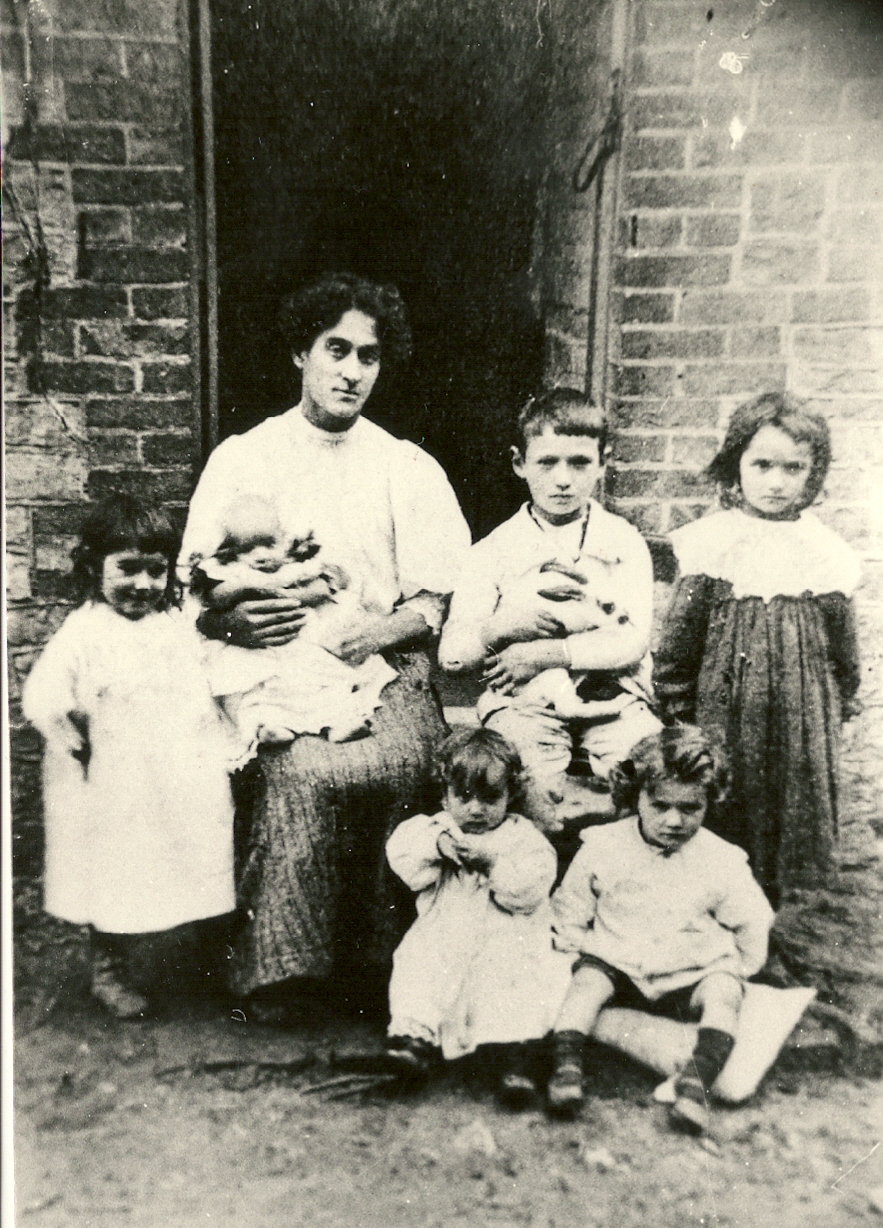
The Bentley Family in 1916. Some of them still reside in Wood Street Village
The families Boxall and Cobbett owned the site for the next hundred years, each family starting as the tenant blacksmith and advancing in wealth and stature. Each ended his days in retirement, living from the rent of the subsequent tenant and his other properties. The smithy was clearly attractive as an investment: John Pink and William Luff, farmers, both owned it for a time.
The next wheelwright occupier did not manage his affairs so well: he died an insolvent debtor. Nevertheless, the property had more than doubled its value, from £145 to £390. His business interests are reflected in his daughters’ marriages: the eldest married a farmer, the second an innkeeper and the youngest a blacksmith. His only son became a wheelwright.
It is not known when the smithy removed to its site on the Green. Daniel Hockley and then William Trigg, probably cordwainers (leather- workers) were the neighbours of the Boylett and Boxall blacksmiths of the late seventeenth and early eighteenth centuries. Thomas Hambledon, a cordwainer, bought the house we now know as The Forge from Trigg in 1722, and it passed through two generations of cordwainers before coming into the hands of George Ellis. In 1812 Ellis borrowed a considerable amount by mortgage for “adding to or building upon the said premises”, but in 1815 he sold to his tenant William Merry, blacksmith. We have not yet established when William Merry became a tenant to Ellis: the facts suggest that there was a period of trade competition if not outright dirty dealing! William Merry (senior?) had been John Pink’s tenant at the ‘White Hart’ smithy in 1790. Thomas Pink (probably the son of John) was trustee to William, loaning him the money to purchase the new forge.
In 1825 John Stedman bought the forge. He and his brother already owned Normandy smithy (Wyke was part of Worplesdon). The tithe map and first detailed census of 1841 give us a clear picture of the Stedman family: John was then about fifty years old, and lived with his wife and family, including his son George, then about twenty years old. There were four other teenage children still at home, as well as three teenage employees. Next door, on the site of the present electricity sub-station, lived his journeyman-smith, Richard Adams. Richard served Woodstreet for over forty-five years and was still working at the age of seventy-two.
These were clearly years of expansion for metal workers. John Chitty (not the wealthy owner of Littlefield) bought Nightingale Old Farm in 1829 and soon set up a wheelwright’s shop there: his business thrived, despite renewed efforts from the ‘White Hart’ wheelwrights. The 1841 census shows no fewer than five wheelwrights working in Wood Street! There were all called John: Chitty senior and junior at Nightingales, and Attree senior and junior with John Wood at the ‘White Hart’.
By 1851 both John Chitty and John Stedman had left off the running of their businesses and taken to farming. John Stedman bought Hillplace Farm: elderly locals still refer to HillpIace as Stedmans Farm in memory of the owners of their childhood days. Steadmans Cottage and, recently, Steadmans Farm derive from the family’s ownership too.
The next phase of expansion was the building of the new smithy and wheelwright’s shop on common land adjacent to the forge. Their copy of the Worplesdon Manorial Court Roll dated 23rd May 1863 grants John Stedman Ounior) admission for “a piece or parcel of land lately part of the waste of the manor (1½ rods) lying at Woodstreet, being part of the site of the blacksmith’s shop there occupied by George Stedman”. The annual rent for the twenty-four-foot-square piece of land was one shilling. Incidentally, John junior was described as a gentleman of Guildford. (George did not gain control of the business he ran until his brother’s death.) It is likely that the wheelwright’s shop was built at the same time. It made sense to have wheelwright and blacksmith on adjacent sites: it must have greatly enhanced their efficiency and potential.
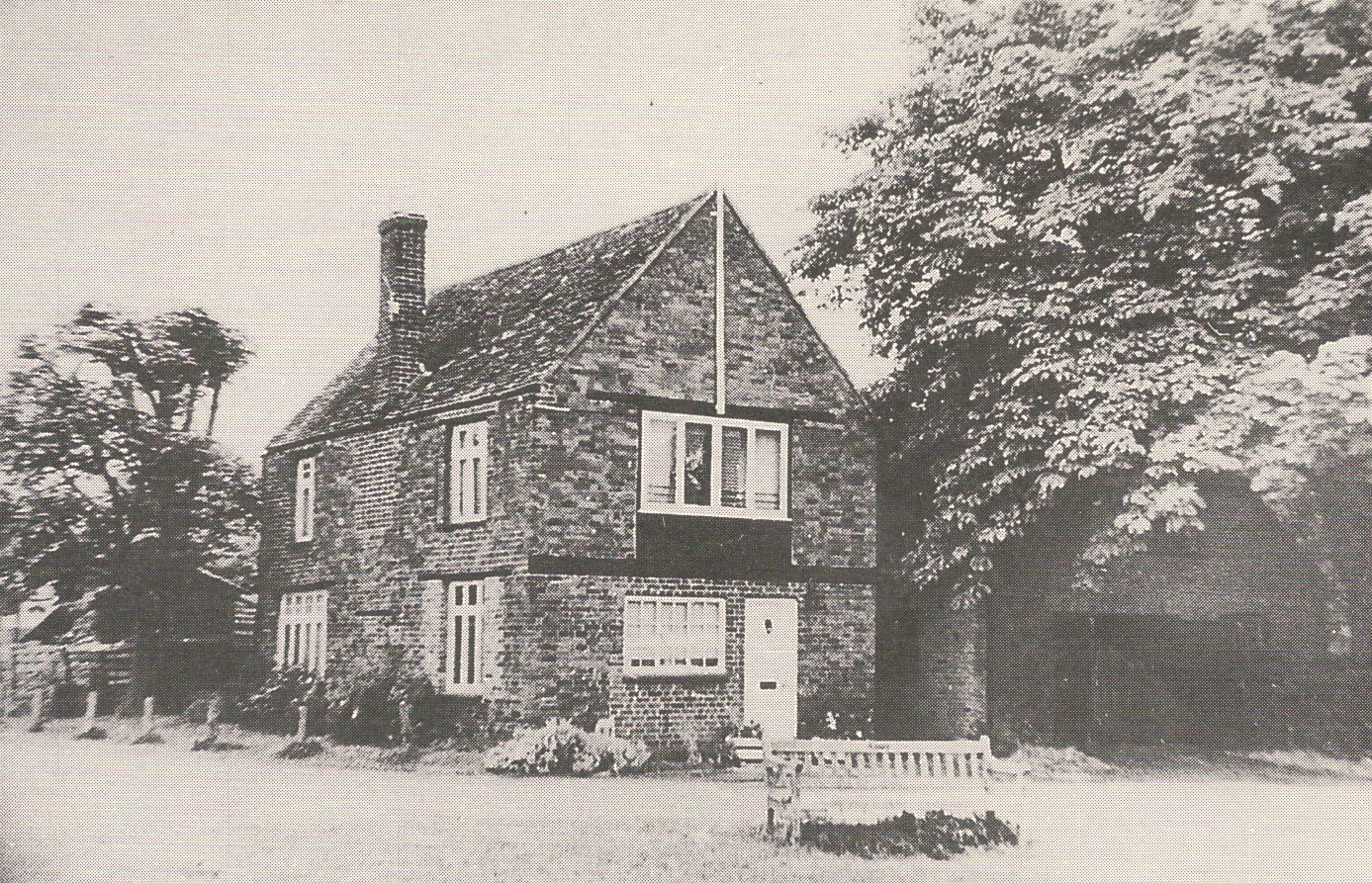
Underneath the spreading chestnut tree. The nineteenth century wheelwright’s and blacksmith’s shop. The wheelwright’s shop was let to Wood Street Branch of the British Legion in 1937, and they used it – after considerable redecoration – as their headquarters until 1954. In that year they moved to ‘new premises on the village green’, which had been built by members with financial help from National Headquarters. ( note: their new premises is now a Christopher Robin Nursery )
Strangely enough, John Chitty junior did eventually acquire the site of the first forge. (You can read the bill of sale in the section on the history of the White Hart as a beerhouse.) His son William continued the business. Lodging with William in 1881 was the twenty-one-year-old employee Albert Stovold, who is still remembered, much loved—and generally known as Grandad Stovold.

The footpath to the White Hart between the Wheelwrights and the Forge was only recently enclosed from the common. The iron tyres stand against the wall of the Wheelwrights in readiness.
John James Bateson took over the forge in about 1880. Kelly’s Directories of 1895 and 1899 give his trades as builder and decorator, sanitary engineer, blacksmith and sub-postmaster. Clearly a man who believed in diversifying with an eye to the future! By 1903, William Young had taken on the business, and it was at about this time that Alexander Pierce came from Yorkshire to work for him—he lived in a cottage on the site of the present electricity sub-station next to the Old Forge. His daughter, Alice, remembers helping Mr. Chitty and Mr. Stovold do the watering for making the wheels. This was the process of shrinking the iron tyres onto the cartwheels. The huge flat iron disc set in the ground, on which the red-hot tyre was laid for the insertion of the wheel, is still in situ.

The Wheelwright’s Iron Mould. Once used for making wheels, it is now set in the ground outside the Wheelwright’s shop.

Albert ‘Grandad’ Stovold, one of the last village wheelwrights.
Alec Pierce became the only blacksmith and remained until 1932. The bellows, still in working order, and other paraphernalia were still there in 1950; his sign lay in a corner of the garage. It read “A. Pierce & Son, Farriers” and was carved with horseshoes and other symbols. The beautiful chestnut tree, so often associated with a smithy, was planted about eighty years ago. It still contains the collar and chains which Alec Pierce used to join up the trunk. This wonderful piece of tree surgery is perhaps the best legacy a blacksmith could leave.