People S
Peggy b1925 & Tom Salter
Peggy was born in Teddington; her father worked as a Jeweller/watchmaker in Brentford High Street. She married Tom in 1951 and had two sons Peter b 1958 & Martin. Peter had asthma, the reason for their move to Guildford in the late 1960s. Tom’s younger brother Freddie Salter was killed in the war. Peggy & Tom lived in Bramble Close, Wood Street. She was a keen gardener and after several jobs settled down working for Cornhill Insurance in Guildford.
Norman Sherwin b 1933
Norman has been a formidable personality within Wood Street village and most importantly Wood Street cricket club since the early 1960’s. He moved to 1 New Cottages, Wood Street Green in 1960 with his wife Valerie and 6-month-old son Philip. He soon showed an interest in the local cricket club and joined at a time of growing membership.
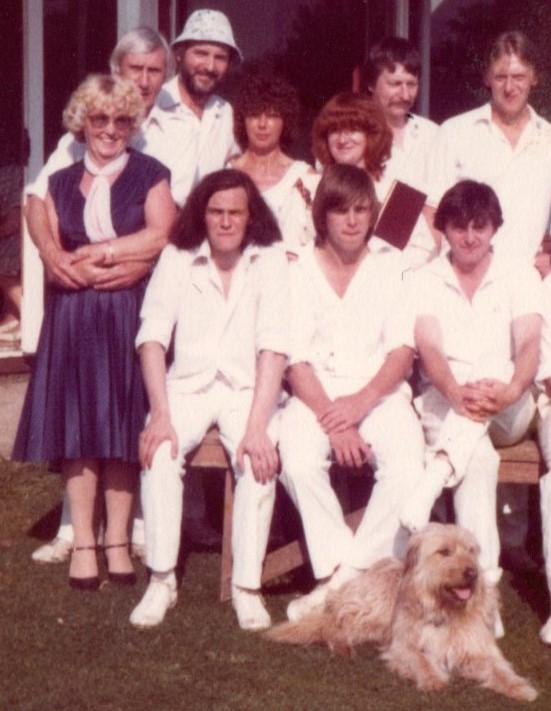
Norman & Val Sherwin (top left), Phil Sherwin (top right), David Sherwin (bottom right)
By 1964 Norman had become Captain and the fixture list had started to grow to more than 24 matches each summer usually played on a Saturday but occasionally on a Sunday. The fixture card show below shows many significant village personalities, the tradition of a yearly dinner had dance had been established and provided a great way to celebrate years endeavours.
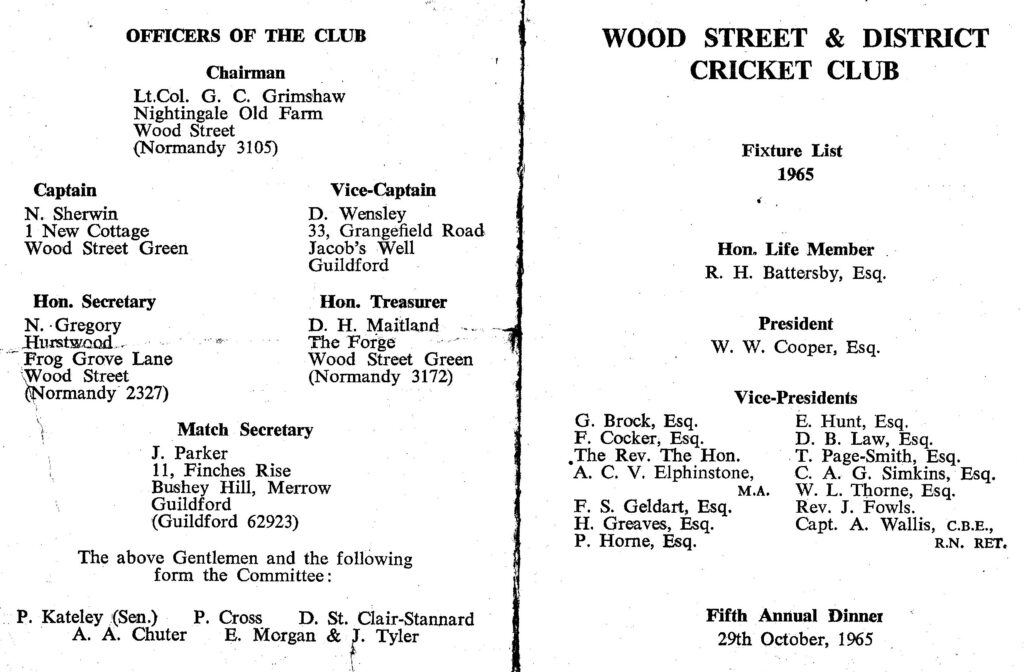
wsvc 1965 fixture booklet
Norman had also established a family cricket team given he had four brothers and two sisters there was lots of competition to get in the team. Wood Street saw a claim to fame with the a visit from the then Australian captain Bobby Simpson who presented a signed bat to Norman as captain of the Wood Street team. In 1969 Wood Street was hosted a celebrity cricket match with many TV and film celebrities such as Barbara Winsor. Norman had a great interest in making the ground and pitch as good as it could be and used his engineering skills to fix and maintain the machines for cutting and preparing the outfield and pitch. You can still see the old concrete practice wicket on the West side of the village green, if you look carefully you can find his initials and the date 1964.
The cricket team went from strength to strength attracting new players, establishing a colts team and joining the Wey Valley league and entering competitions such as Flora Dora. Norman was club captain when Wood Street won the Admiral Dunlop competition at Guildford in 1979. Norman had established himself as one of the team’s premier bowlers and was certainly feared by opposing teams. On numerous occasions he took over 100 wickets a season. During this time Norman was working for British Airways and used his cricket skills to travel around the World playing for the BA representative team. Many fantastic years were spent running and playing cricket on the village green right through to the late 1980’s when it became apparent the next level of expansion couldn’t be accommodated on the green. Norman was instrument in the negotiations and movement of the club to its new ground on Backside Common, previously used by Wood Street football team.
Norman along with several dedicated members such as John Morley, Clive & Bruce Tester, Gary Dobson, Richard Trinick and many others established a new ground with a portacabin pavilion opened by Surrey’s Ian Greg in 1991. A new era had begun for the club thanks very much to the tenacity and dedication of Norman Sherwin. Norman played his last games for Wood Street in the early nineties and dedicated his time to Golf at Puttenham and Bowls at Guildford. He also provided help and made many friends around the village in his later life. Thank you for your dedication to Village life and the passion you put into the village cricket club.
For more information on the Cricket Club history and photographs click here
Derek Sillence b 1933
Derek moved into the newly built Jubilee Cottage, Wood Street, with his mum & dad and two brothers in 1937. The shop next door was a Shoe Repairer business named ‘SNOB’. It later became the Newsagent. He had various jobs, a milkman for Harding’s, nursery work, a toy factory in Clasford making wooden toys, but mostly in the building trade. He recalls whilst building Fairlands estate foundations they unearthed a lime pit believed to be the relic of an old Quakers Cemetery.
He recalls in the 1930s & 40s that Hillbrow, the house between the School and New House Farm Lane was a shop that sold bread, before becoming a Fish & Chip shop run by Mr & Mrs Hammond. His many memories include the village school where Mr Goddard was the headmaster & Mrs Barnes & Bowles teachers. He says that the boys were caned regularly by Mr Goddard. Their swimming pool was Pink’s Hill Pond was complete with diving board. There was carp in the pond near Hollybush Farm, a Mr Clark sold rabbits to Guildford Market for 6d (2.5p). They would take eggs to the American GI camp on the Hog’s Back in return for chocolate & chewing gum. They would sell a bushel ( 300mm high basket) of acorns to the local farms for 2d. The landlord at the Royal Oak was a Teddy White – he says the children used to chant to him – ‘No Ale, No Stout Teddy Whites sold out’!
The Smith Family
Refer to the Yellow Book for more information. There are very few Smiths recorded in Worplesdon Church records, perhaps because they were Quakers. Stephen Smith owned land in Brad Street, Thomas Smith lived in the ‘Woode’ (Perhaps Pinks Hill,) in 1610.
The Smither Family
Refer to the Yellow Book for more information. Thomas Smither was a Billman recorded in the 1853 Muster to arms. Like the Smiths above, the family appear to have lived in Broad Street for three hundred years without a Parish Baptism of Burial!
Thomas Slaughter b 1823 married Eliza Hartfree in 1846
The third child of eight of William b ~1795 & Jane Slaughter b ~1801 nee Etherington. His father was a carter from Worplesdon who farmed 5 acres, & his mother was from Ash. In 1841 he and his younger brother George were servants at Frog Grove House. By 1861, Thomas was a successful tenant farmer with 45 acres in Compton & later in Pirbright. In 1892 aged 69 he and Eliza moved to Frog Grove House where they farmed Frog Grove and Russell Place Farms. Thomas died in 1901. They had five children. Eliza 1848, Alfred 1850, Thomas was their fifth child 1856.

Thomas Slaughter
Toby Herbert Page Smith b 1907/8 & Alice Mary Dorren nee Pierce.
Alice was the last of six children born in the village to Alec Pierce a blacksmith. Alec came here in 1900 from Wiltshire. Toby carried out extensive works around the village still seen today. He carried out the metal work for the Flagpole & Village Sign. The sign being designed by Mr Crosby-Cook living at the Forge. He did work on the Chestnut tree outside the Forge, drawing the trunk together. With Harry Smith of Oak Hill, he put in drainage around the Maypole on the Green. He arranged and helped clear & prepare the football pitch at Backside Common – his name prevails as the Cricket Club pitch is named Toby’s Oaks in his memory. Toby and William Baigent were founder members of the Wood Street British Legion.
Wood Street Commons were cleared of cattle in 1946 after the war & double fences were erected to try to stamp out TB in Milk. At that time the commons had few bushes & wonderful wildflowers and watercress.
Max Spencer b 1892.
Born Max Spiegel in 1892 in Breslau, Poland. Educated in Brussels he returned home in 1914 for his sister’s wedding. During that visit war broke out & he ended up fighting deep in Russia and at the front in France for the Germans as a sapper. He married in 1920 then working in his father’s textile business. They came to London in 1939 to escape the Nazis, leaving all their belongings behind. Shortly after that War was declared and Max volunteered for the Pioneer Corps changing his name to Spencer & had the privilege of serving the British Army coming back home from France three weeks after Dunkirk.
The Spencer family moved to Frog Grove Lane in Wood Street in 1942. Their two daughters and a son finished their education in Guildford. He worked for a firm of engineers in Shalford for twenty years. He became Branch Secretary of the Wood Street British Legion.

Max Spencer ( Spiegel )
Iris Payne nee Southerton b 1915
Iris was born in Wood Street in 1915 in the end cottage on the Village Green next o the old British Legion ( now a children’s nursery). As a child she moved to 2 Holly Cottage, Holly Lane and then when married after the war moved to Pound Hill. Iris worked in service living in at Frog Grove House and then domestic work at various houses in Frog Grove Lane. Cleaned the old Church & then the new one, cleaning the Church Halls from 1950 to 1970.
Iris, aided by Betty Lock recall; the signal box at the end of Pound Lane, run by Ben Mitchell & later by Mr Frost until the box and the adjacent house were demolished. She recalls that Tudor Cottage, Frog Grove Lane, was originally two farm labourers’ cottages with a rent of 3sh & 6d (18p) in the 1920s – deducted from the farm workers’ wages.
Her father was a builder, he built Woodlands Farmhouse, Billhurst Cottage and converted Clovers, White Hart Lane from a Barn to a house. The White Hart was run by the Lintall family for many years, its beers all drawn from taps in barrels, & it had a sweet shop attached for the children to spend their pocket money. Where the British Legion was built on the Green was a corrugated Iron shed, workshop owned by a Mr Narrawy.
Sheila Hick’s nee Spink. B ~ 1936
Sheila lived in Wood Street from 1942 to 1959 in Oakley, opposite Frog Grove House with her mother & Father Cecil & Kitty Spink. The bungalow was built for a Mr Harrison, merchant navy, who let it to a young couple called Freeman. They let it to Mr Frank Cooper, who lost both his legs early in the war. She went to Wood Street School in 1942 to 1947 from where she went to Northmead Secondary modern under the new education act.
She recalls ‘The Lady Chimney Sweep’ Mrs Walker & Shetland Pony Silver. Mrs Walker would go to Kent hop picking in the Summer. Living near Sandy Lane was a wonderful place. There was a sandpit in the field to the left where hundreds of Sand Martins nested in the summer. During the war the Home Guard used the sandpit for target practice.
A V.E. party weas held by Mr & Mrs Goddard with games, fancy dress, & tea. Later, possibly 1946, Lady Clay of Inholms Farm organised a coach trip to Bognar for all the village children to celebrate the end of the war. Jus after the war the Horticultural society was formed, with the flower show held in Mr Gammons field behind the pond. The Flower Show in the Coronation Year, 1953, was bigger & better than any – the idea of a Flower Queen was introduced and the Maypole restored on the village green.
Jimmy Gammon lived in Hill Place Farm – he delivered milk by van. A gentleman called the ‘Roadman’ appeared very old to us children. He rode a large tricycle, working on trimming verges & clearing ditches. He retired & a Mr Reddick took over his hob. Mr Puttock, the ‘Fishman’, lived in Normandy, but Thursdays was Wood Street’s Day. He sold tins, biscuits, ‘Camp’ coffee (with chicory), fresh fish and paraffin for Valor paraffin heater & oil lamps. Mr Wye from Classford Bridge, would ride around the village on his bike on Mondays collecting shoes for repair – returning them the following Monday. Mrs Goddard was the school master’s wife. She was very kind, helping out with lessons & dinners if anyone was away. She was also the librarian & ran the Mother & Baby Clinic in a classroom and later in the Church Hall.
Miss Goodchild’s Store was full of chemist’s goods, stationary, wool, baby requirements, underclothes & stockings. Jubilee Stores was run by Mr & Mrs Reeves. Mr Reeves with his wooden leg managed to ride his motorbike & sidecar to deliver newspapers & groceries.
Jean & Betty Hester were in the ‘Guides’ with me. Mr Hester was very kind to us, driving over to Haslemere when we were camping to bring us goodies. The Guides were run by Miss Connie Cateley ( Kateley? ) with Daisy Cousins as her lieutenant. The Guides disbanded in October 1948 as Miss Kateley was ill. The owners of ‘The Wee House ?’ ran a cattery from there called ‘Tibby’s Tavern’. Big changes came with the building of the Pound Hill Estate just after the War.
Derek St Clair-Stannard. B 1919
In 1942 Sub-Lieutenant Dere St Clair-Stannard was a 23-year-old Royal Navy Officer when he set sail from Portsmouth on board the HMS Queen Emma. He played his part In the infamous Dieppe Raid that took place on August 19th, 1942. The ship was loaded with landing craft and mostly men from the Royal Canadian Regiment. The plan was to attack the German occupied port of Dieppe, but the force was spotted early by the Germans, and the element of surprise was lost. The attack was a disaster with over 3,600 out of 6,000 men who made it ashore were either killed, wounded or captured. High command learnt lessons from this disaster in their planning for D-Day landings in 1944.
Dereks honours included a military MBE for the role he played in the liberation of Greece, and the Legion d’Honneur, France’s highest decoration, awarded for outstanding achievements in military & civilian life.
Derek lived in Wood Street until 1981 when he & his wife Ann in alter life moved to Godalming. They had brought up their four children in Wood Street.
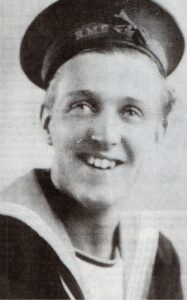
Derek St Clair-Stannard 1939

Derek St Clair-Stannard 2005
Doris & Arthur Stock – Daughter Joy Stock
They had two daughters Louis Eileen b 1921 and me, Joy? and a son Robert Arthur b 1933. I was born in Fern barton Broad Street in 1931, one of the cottages that faced the common. A few houses were owned by Drummonds. The end house towards Wood Street was owned by a Mr Jarvis who had a wood business. There was an allotment with fruit trees behind the houses. Two thirds of the way along a Mr & Mrs Minks lived. The lady was deaf & my mother learnt sign language to converse & used to take her hot meals occasionally.
I recall my teachers at Wood Street School, first Miss Bowles & later Miss Barnes, who both travelled from Guildford by bicycle. Discipline was strict; Miss Barnes chastised a boy for bad language by leading him by his ear & washing his mouth out with carbolic soap. At mid-morning, Horlicks was provided for one penny – regularly emptied down the sink as distasteful. Later, one third of a pint of milk was provided throughout Winter. The headmaster was quite intimidating and not very complimentary of children’s prospects.
During the war, we had an air raid shelter in the playground. During the Blitz, we were on the flight path from the coast & sometimes they were low enough that we could see the intimidating black German crosses on the wings. On one occasion, we could see red glow from fires in London & we could hear the sound of doodlebugs.
During the holidays, we collected Rose Hips which the local authority bought to make syrup. My father joined the home guard ( we had a hall full of Mills Bombs; hand sized pineapple shaped grenades) & worked at Dennis Bros as chief inspector of tanks which they manufactured. My brother Robert was in the Parachute Regiment & survived Arnhem by swimming the Rhine. Later Robert served in Norway, India & Egypt. During the war, the common in front of our house was cultivated by Italian POW’s.
In 1940 my mother took in 3 young girls evacuated from London. Jkean, 5, June 6 and Yvonne Short, 7. Toys were usually handmade – a rocking horse made from the wooden rollers of a mangle. Food was always a worry. Mother would not buy anything from the Black Market. Visiting friends involved taking a sliver of butter, sugar & tea, Rabbitts were occasionally available. Pocket money went on a penny stick of toffee or a treat was the ‘stop me and buy one’ tricycle from Eashing Diary Farm with real strawberries. The village Show was always a highlight with side shows, coconuts, swing boats etc. In the late 30’s the Aldershot Tattoo was an event of the year – walking home over Backside Common. I married in 1951 after Art College in Guildford & then started working at clothes maker Rockfords. We moved to a new house nearer Guildford. My parents lived in Broad Street until 1960’s when they moved to be closer to me.
Arthur E Stock b 1898.
In 1926, Arthur, wife & family moved to Wood Street from Worplesdon. Hr recalls the pack of fox hounds kept at Merrist Wood & the days of the hunt when some of the boys & men of the village were employed as loaders & beaters for the day. The boys were paid a shilling (5p) , beef sandwiches & mineral water. The men were paid two shillings & six pence, sandwiches & beer and an occasional rabbit.
Arthur lived in Fern-Barton Broad Street from 1925 to 1966 when he moved to Blackpool. He was a parish councillor & helped arrange the Wood Street festivities of King George VI and Queen Elizabeth’s Coronation in 1937. Arthur received a chiming clock to recognise his efforts as Hon. Secretary of the newly formed Wood Street Horticultural Society and their first annual flower show, 1st September 1938. He also was involved in forming the Home Guard with Col. Adair of Pinks Hill & Col. Marriot. They included the motor cyclist Sgt. Paddy Johnston, a well-known TT rider. Initially all the ammunition was kept in his garage, later moved to an army hut on Normandy Common. The ammunition included six so called ‘pikes’, old bayonets welded to steel tube that were never issued out.
Gordon Allan Stewart b 1923.
Gordon lived at Cedar Mead, 131 Oakhill, Wood Street Village.
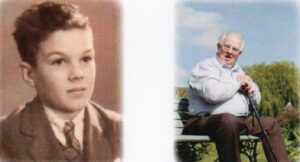
Gordon Stewart