People T
Susan Stubbs nee Thomas
Susan came to Wood Street in 1946 when they moved into a new Prefab on Pound Hill. She went to Wood Street School also in 1946 when Mr Goddard was the headmaster. The Rev Wynne Jones and his wife ran a club in the church hall for children. They would play on the common & walk to Pinks Hill level crossing where they would pick strawberries on the railway bank. They would also pick Oxeye Daisies & cowslips on the meadow by the stream.
She went to Brownies on a Monday in the church hall. Brown Owl was Barbara Dunkinson nee Telling from Rydes Hill about 1954. She recalls that two children were murdered in the copse over the level crossing. She also would walk to Sandy Lane Sand Pit to play & watch the Sand Martins, a memory shared by Sheila Hicks earlier.
Walter (Wally) Leslie Thorn.
Wally was the landlord of the White Hart for 16 years. Before the war he served in the Essex Yeomanry and was specially trained to take part in the D-Day landings in 1944. After that he was involved in the liberation of France & Holland. He married Margaret Ena (Meg) b 1914, who helped in the White Hart for many years until Wally retired in 1967.
Violet (Vi) Eileen Thorp b 1900 and Sister Gladys (G) Thorp.
G & Vi were daughters of a Castleford, Yorkshire colliery owner with a family of six girls & two boys. Her father was Thomas Hall Thorp. When the family fell on hard times, the family went to stay with relatives all over the country. Vi came to live in Send. G lived for a while at Artington Hall, near Leeds from 1890 to 1896, retired from teaching & joined up with Vi in 1941 when they moved into Woodlands Farm Wood Street Village. Vi started a market garden on 4 of their 11 acres. A member of the Horticultural Society & responsible for the Church vestments, & an active member of the Mother’s Union.
Photo G & Vi driving their van

Viv and Gladys Thorp
Ken b 1932 & Ann Tizzard.
Ken joined the Surrey Constabulary in 1960 as Police Constable 240. After training he was allocated the police House on Pound Hill in Wood Street. He lived there with Ann for 23 years before they moved to the village green. Previously, he had been called up to the Coldstream guards and REME. He was a qualified Army marksman. In the 1964 he arrested one of the most wanted criminals who had escaped from Wormwood Scrubs – spotting him on the Guildford By-pass.

Ken Tizzard and Son Jeremy 1963
Ann retired after 25 years as a swimming & diving instructor. She taught at Spectrum from 1993 to 2003, teaching up to 16 classes a week, taking very young non swimmers through their badges through to advanced level.
Lord Roger Grenfell Toulson b 1946
Roger & Lizzie lived in Billhurst Farm, Wood Street Village from the 1980’s for forty years, raising their four children.
He was called to the bar in 1969 after graduation from Jesus College Cambridge. He worked his way up to Judge of the High Court of Justice, being Knighted, chairman of the Law Commission, promoted to Court of Appeal and in 2013 appointed as Justice of the Supreme Court of the United Kingdom; this entitled him to the title ‘Lord Toulson’. He retired in 2016.

Lord Toulson
Lady Elizabeth (Lizzie) Toulson nee Chrimes.
Lizzie qualified as a Barrister before becoming the youngest ever chairman of the Women’s Royal Voluntary Service supporting their members and alongside the Army, providing services welfare support worldwide. Awarded a CBE for her voluntary work. She was appointed the chair of ‘The Children’s Society’ Charity. Lizzie was also the High Sheriff of Surrey in 2009/10. In addition to her charity work, Lizzie was an active member of Wood Street Village community life.
Samual Todd b 1868 & wife Lily nee Swansbury.
Lily’s father was Thomas Swansbury, a farm worker from Wood Street. Lily’s mother was Jane nee Stone b 1827. Thomas and Jane lived at Hillside Pinks Hill. Jane was the daughter of a Wood Street farming family, her Father, Stephen Sone b1800 and Mother Charlotte Slaughter b 1803. All longstanding farming families in Wood Street. There are possible family connections to the Huguenots, (French Protestants) known to have settled in the Wood Street area .
Samuel Todd and Lily had 10 children between 1890 and 1910, four born at Hillside Pinks Hill and six born at 1 Broad Street their new home. Florence Elizabeth born in 1902, has written her memories of Wood Street:
Florence Elizabeth Todd b 1902.
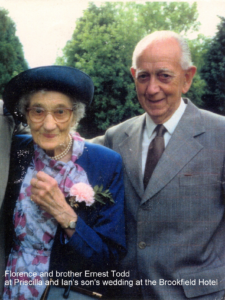
Florence and Ernest Todd
Born No 1, Broad Street, Wood Street Village, the family moved to Eagle Road, Guildford about 1914. I was a postwoman during WW2 and then worked in the Binding Room at Biddles. My earliest recollections in about 1908, looking out of the school window to the field opposite and watching the huntsmen following the hounds. On British Empire Day (24th May) walking to Wood Street Green to dance the maypole. The army would hold mock battles on the common which were a great occasion for us. At the end of the manoeuvres, the army cook emptied the food that was leftover into a large bath for our pigs. We enjoyed Bonfire nights. The boys used to light a big bush on the common and let off squibs, jumpers and catherine wheels.
My Mother, Lily, kept chickens, geese and pigs; at Christmas she sold the geese to customers. The bacon was smoked up the wide chimney where there was also a large oven in which bread etc., was baked. She also helped her parents who had a smallholding by taking the produce into Guildford by donkey kart to sell for them. My Grandfather, Stephen Stone, dug out a spring on the common and surrounded it with small trees and shrubs. This was used for many years to water the gardens. My Father, Samuel, was employed by Gates and Co in Guildford. He had to be at work at 7 am. His work often lasted late into the evening as he had to receive the late churns of milk brought in by farmers after the afternoon milking. There was no refrigeration in those days, so the milk had to be separated and kept cool in a hole in the factory floor. He was a butter maker for Gates Dairy for 28 years. His starting wages were 20 shillings (£1) per week. When he finally left, his wage had risen to 27/6d (£1.35p) per week. He had to walk the three miles every morning and evening as there was no transport.
Often, when my father arrived home, there was a row of children’s shoes to be mended, placed along in front of the fire fender. In country areas there were no streetlamps. The streets in town were lit in my young days by a lamplighter, who used to come along the streets with his ladder to climb up to light the gas. There was no electricity at all. Gas was made in the big gas works in the town. Cars were almost unknown, only carriages and horses. No taxis, only horse-drawn cabs. Washing had to be boiled in a huge copper which was heated underneath with any rubbish you wanted to get rid of. No dustbin collectors existed.
My parents told us they had very little schooling, Mother Lily, had to pay a 1d a week but left at the age of 12 years to go to work but she could read and write very well. In the winter, Mother sent me to the butcher, Mr Sparrow in Stoke Road, for threepenny worth of rinds and bones. These were put into a huge iron pot with all sorts of vegetables, onions, carrots, potatoes, swedes, artichokes, turnips, leeks, and it smelled lovely. It was cooked on the Kitchener where a lovely fire warmed the room. (The very first range cooker, the Kitchener was invented and built by Rangemaster in 1830 in their factory in Leamington Spa.)
When we lived at Wood Street all the village schools from Stoughton, Wood Street, Pirbright etc., were invited to a lovely Manor House by Sir George and Lady Walker. We would have trips on the lake and scrambles for sweets, races, and altogether it was a lovely day. There was also the annual Flower Show which was another great event for us. I remember we had to pick wildflowers to bunch together for a competition. The best entries got a prize.
Rydes Hill had a little meeting place, which is now the Women’s Institute, where we went for Sunday school and the other Services officiated by Mr Lacy, I think. There was no assistance for the poor, no help in times of sickness. The workhouse existed, and those children who were unfortunate enough to be without homes were slighted very much. They were all dressed alike, the girls especially noticeable in check dresses. As an outing, a bike would be hired from Mr Monks cycle shop for sixpence an hour and we would cycle back to Wood Street just for the pleasure with my sisters Jane, Mary and Daisy. The first world war was on at this time, and my brother Tom b 1898 joined the Royal Navy and served on HMS Achilles. After the first World War he couldn’t find work, so he signed up for the Royal Fusiliers, Russian Relief Force, and was sent to Russia to fight the Bolsheviks in the Russian Civil War. Whilst on a march through a forest, one of the soldiers lost his rifle so the sergeant sent Tom back with him to look for it. Unfortunately, he ran into the Russians and to try to escape swam a river, but found they were surrounded on the other side. He was taken prisoners and held in Moscow and Archangel for some time before being released.
During the second world war, able-bodied people had to do work of national importance. I did not wish to go to a factory so joined the post office. Often while delivering the letters the warning siren would go and I had to dash into any house to get under their air-raid shelter. Quite a number of bombs fell on Guildford and people were killed. The winters were exceedingly cold with deep snow lying for long periods which made walking the post rounds difficult. An Officer and company of soldiers visited each house in the street to tell the owner how many men were to be put in each; they chalked the number on the wall, we had four. They slept on the floor in the front room. Very nice young men. Two were wounded and brought back to the High School, Farnham Road to recover. All the railings and gates etc were removed from houses for the war effort. We lost ours in Eagle Road and they were never replaced. There were the ration cards, 1/2 lb sugar, 2 oz butter, 1/2 lb meat per person per week. Many things were in short supply. We had clothes coupons, but poorer people could not afford clothes and so sold their coupons. At the signing of the Armistice, there was much rejoicing. Every street had its party held outside and all were invited.
Another wartime memory is when two planes collided in Stoke Park one morning. The explosion over the town was enormous and many houses were damaged. The doodlebugs, which were sent over were very frightening. One came over our house and landed in the recreation ground, causing a lot of damage and injury from flying glass. All the windows in Recreation Road were blown out and ceilings came down.
All of us, except my youngest brothers Joe and Ern, attended Wood Street School. Daisy and I only went until we were about 6 and 8 years old when we moved to Guildford and attended Stoke School. Tom finished his schooling at Wood Street, as he used to drive the village nurse on her rounds while he was there. Mary passed a scholarship exam and was able to leave school at the age of 12 or 13 as she had learned all they could teach her.
Sam, my eldest brother, b 1890 worked at Thornycrofts in Basingstoke after his apprenticeship at Drummond Bros in Wood Street then he was employed by Vickers Armstrong at Weybridge for 39 years. My brother Joseph Robert b 1906, after leaving school joined the Merchant Navy and was in China about 1927 during the Nationalist fighting. He became very ill and had to be left in a hospital where no one spoke English when the ship sailed. I think he was there for about six months before a captain of a ship contacted him and brought him back to England. He worked for a number of years at Vokes, Worplesdon where artificial limbs are made. Ernest was twenty years younger than my eldest brother Sam. Lilley b 1892, Sarah Jane b 1896 and Mary b 1897, were much older than me and were all out to work before I started school. Jane went up to London and worked for Sir Thomas and Lady Nichol at 28 Park Lane. Daisy went as a missionary to Africa; she sailed on the S.S.Tanganjika & married Thomas Dawson in April 1919.
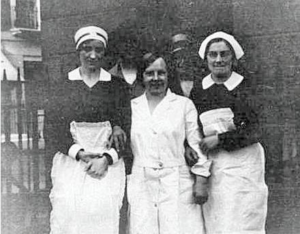
Florence and Agnes