The Green, like all Wood Street commons, was sold to Surrey County Council by Lord Onslow in 1964. It is not clear how long it had been used as a green by the inhabitants. We assume that it became a green by “continuous and open use by the inhabitants for sports and pastimes for at least twenty years without protest from the Lord of the Manor”. A book produced in 1828 paints the following delightful picture:–
“At the foot of the hill, southerly, is what is called Woodstreet, with a stately May-pole standing upon a littel green plain, a sad memento of the ‘Merrie days of old England’, when men had not learned to calculate the sum upon which the industrious peasant could exist.”
Most Surrey villages had maypoles until the early 1800s. These, of course, were the old English maypoles—tall, permanent masts, which stood on the greens. They would have been hung with flower garlands on May Day and around them circular dances would have been performed, the dancers holding hands. These dances, along with the poles, had been forgotten in the 1880s when the ribbon-plaiting dance around the short maypole was introduced to schools. In Wood Street, though, the old pole was renewed in 1871, the Surrey Advertiser of 6th May 1871 giving the vital report:–
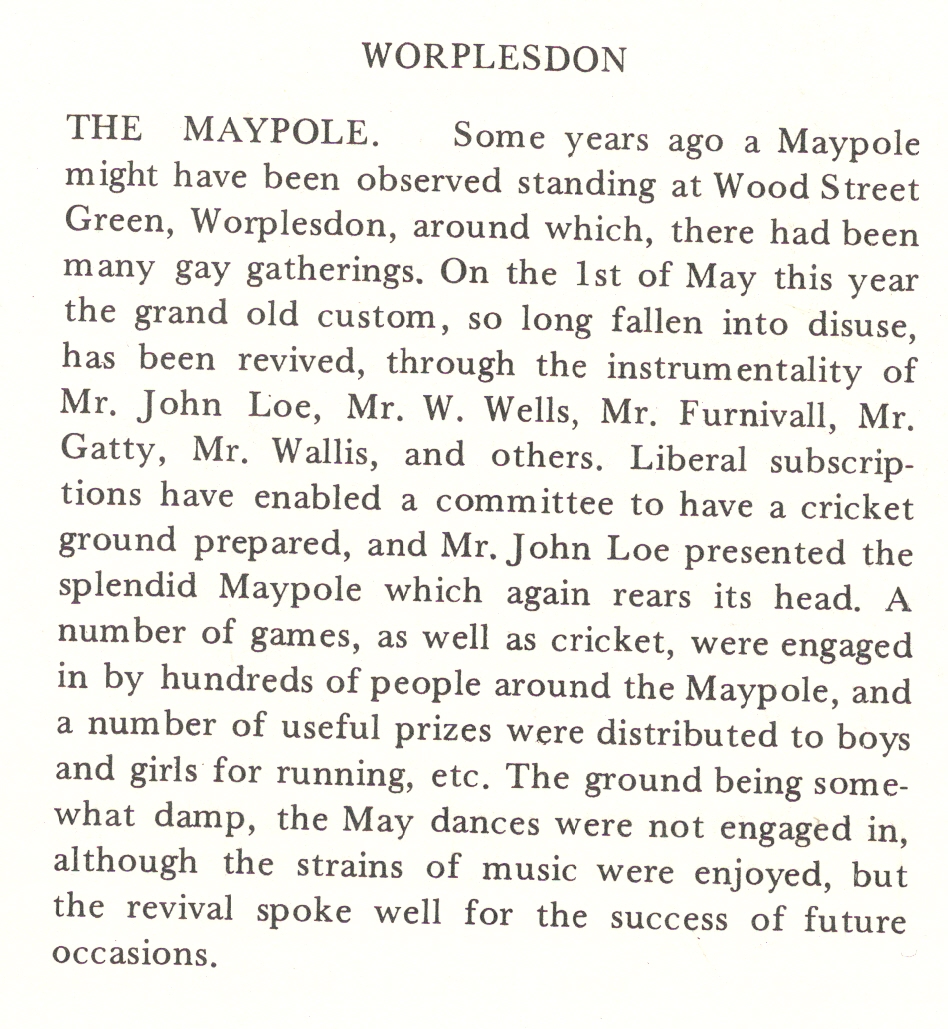
Surrey Advertiser 1871 Wood Street Village Green Maypole renewal
The custom of ‘garlanding’ was also common in Wood Street. This custom was also sometimes called ‘maypoling’. Children went from house to house with a garland or pole decorated with flowers, rather in the fashion of ‘penny for the guy’. Worplesdon School Logbooks show absences on May Day for this purpose in the 1870s and 1880s.
Wood Street’s May Pole—renewed again in 1953—is the only one still standing in the County, and it is thought that the reason why it was not forgotten was because an annual May Fair was held on the Green.

The only remaining Maypole in Surrey renewed in 1953
The success of the Fair was reflected in the truancies from school on the First of May during the latter part of the nineteenth century. It is said that the Green was always crowded for these fairs and that Wood Street had a very good band. Council Minutes (1911 to 1920) contain references to the Fair held on the First of May each year and the tolls collected. In 1911 the tolls amounted to seven shillings, and the Council agreed to reduce the tariff for 1912. The new scale of charges for booths at Wood Street Fair was:–
Roundabouts—————————————– each 20s.
Shooting Gallery—————— down from 5s. to 3s.
Coconut Stand———————- down from 5s. to 3s.
Swing Boats————————- down from 5s. to 3s.
Side Shows————————— down from 5s. to 3s.
Ordinary Stand——————– down from 2s. to 1s.
The Clerk visited the Fair on the First of May to collect the tolls of 16s. due, but was only able to collect 11s.: he could not extract the balance from the stall-holders. The Council decided that in future the payment would be collected before allowing stall-holders on to the Green.
In 1915 the Clerk reported that no tolls had been collected because no booths had been erected. A horse and cattle market had been held early in the morning. Was it the war which brought the end of the Fair, or the unusual weather? It snowed!
The Fair was revived in its modern form by Wood Street Horticultural Society in 1947 (Flower Shows were inaugurated in 1936 ( or 1938 ))—a small forerunner horticultural show had been held in a field for four years before the war. New booths were made and run by members of the British Legion and the Horticultural Society, and extra money was earned by hiring them out to other village fêtes.
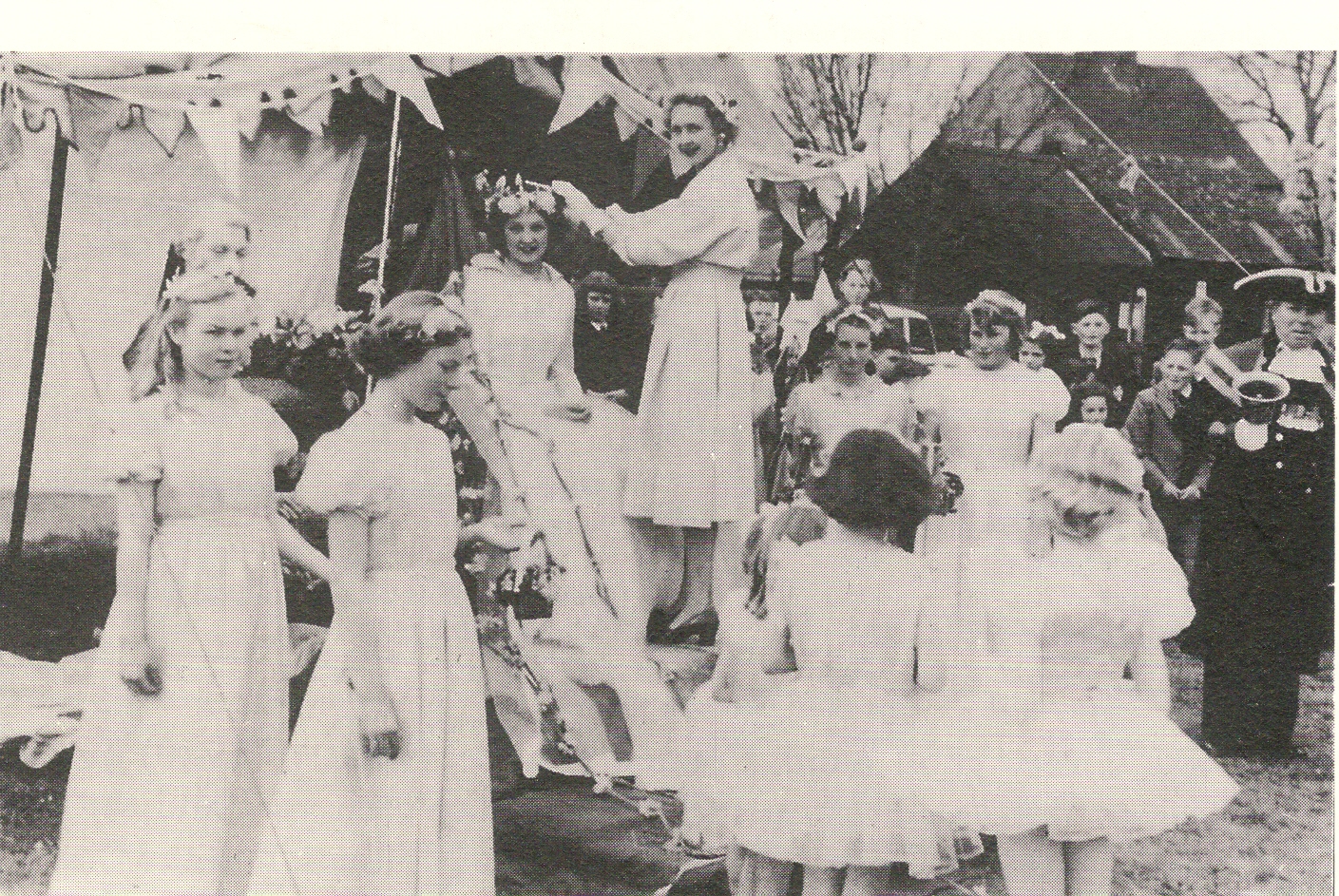
The first modern Flower Queen, Beryl Cooper, in 1953. She was crowned by an actress, Miss Betty Ann Davies. Miss Davies lived in Wildfields, converting it from two keeper’s cottages into an attractive home. In the background of the photograph you can see the dwelling once occupied by the blacksmith’s chief employee: it could possibly have been built before 1722. During the war this building was used as a First Aid Post and an A.R.P. (Air Raid Precaution) Hut
Cricket in Wood Street was born out of the 1871 renewal of the Maypole, when “a cricket ground was prepared”. It is not known when Wood Street Cricket Club was officially formed, but locals have fathers and grandfathers who were members.
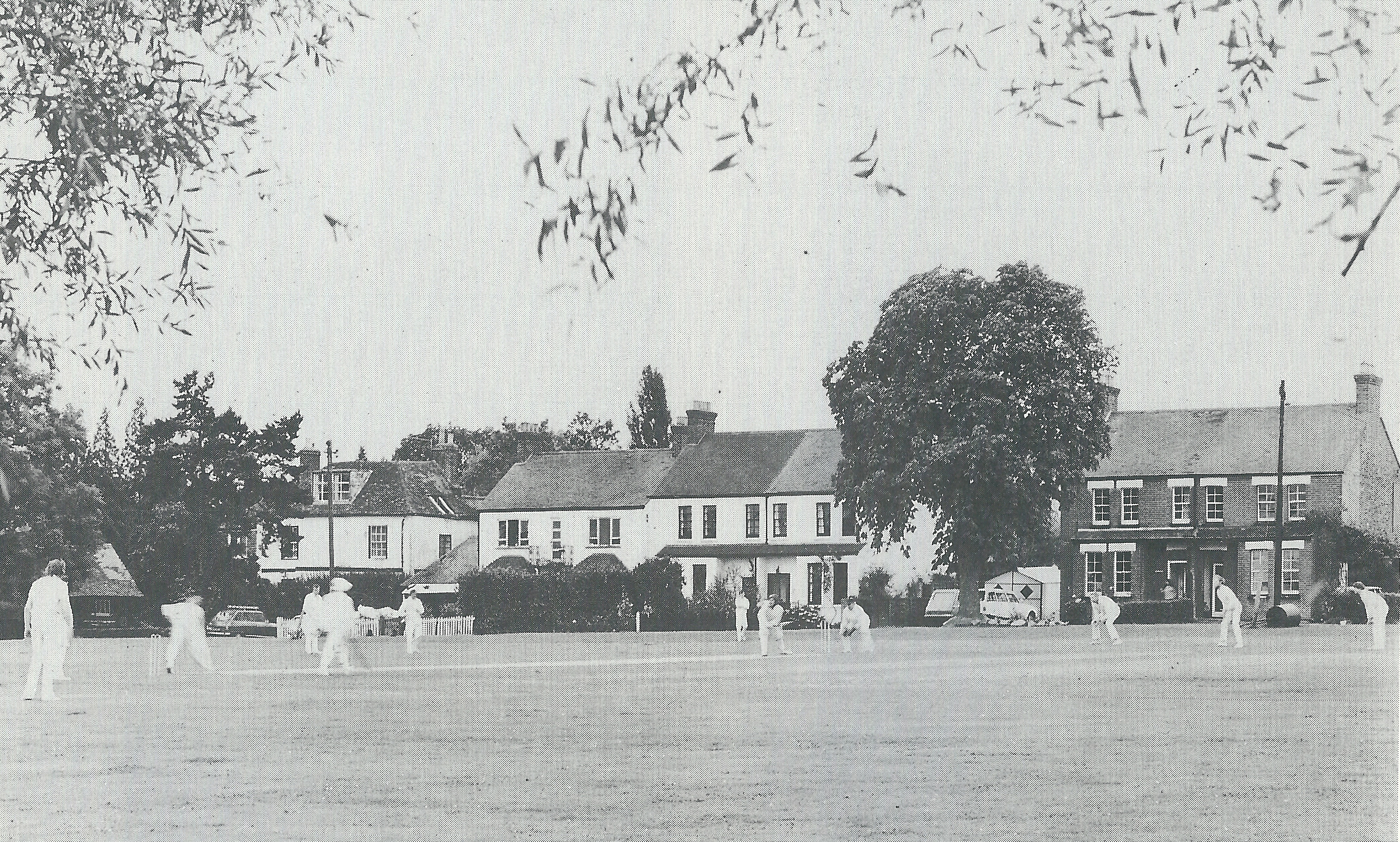
Cricket on Wood Street Village Green 1980. Everyone’s idea of a typical village green.
Parish Council Minutes state that on 3rd July 1913 it was reported that Dennis’s Athletic Club had been playing cricket without permission. The secretary of the club apologised and requested permission of the Parish Council to play on the Green, but unfortunately the intervening three weeks had seen the collection of a petition signed by thirty-seven Woodstreet householders objecting to the cricket. (Perhaps thirty-seven members of Wood Street Cricket Club?) Eventually Dennis A.C. were allowed to continue playing for the rest of the season. At the close of the year Drummonds A.C. requested the use of the Green for the following season’s cricket, but they later withdrew their request—one wonders if they were made more welcome elsewhere!
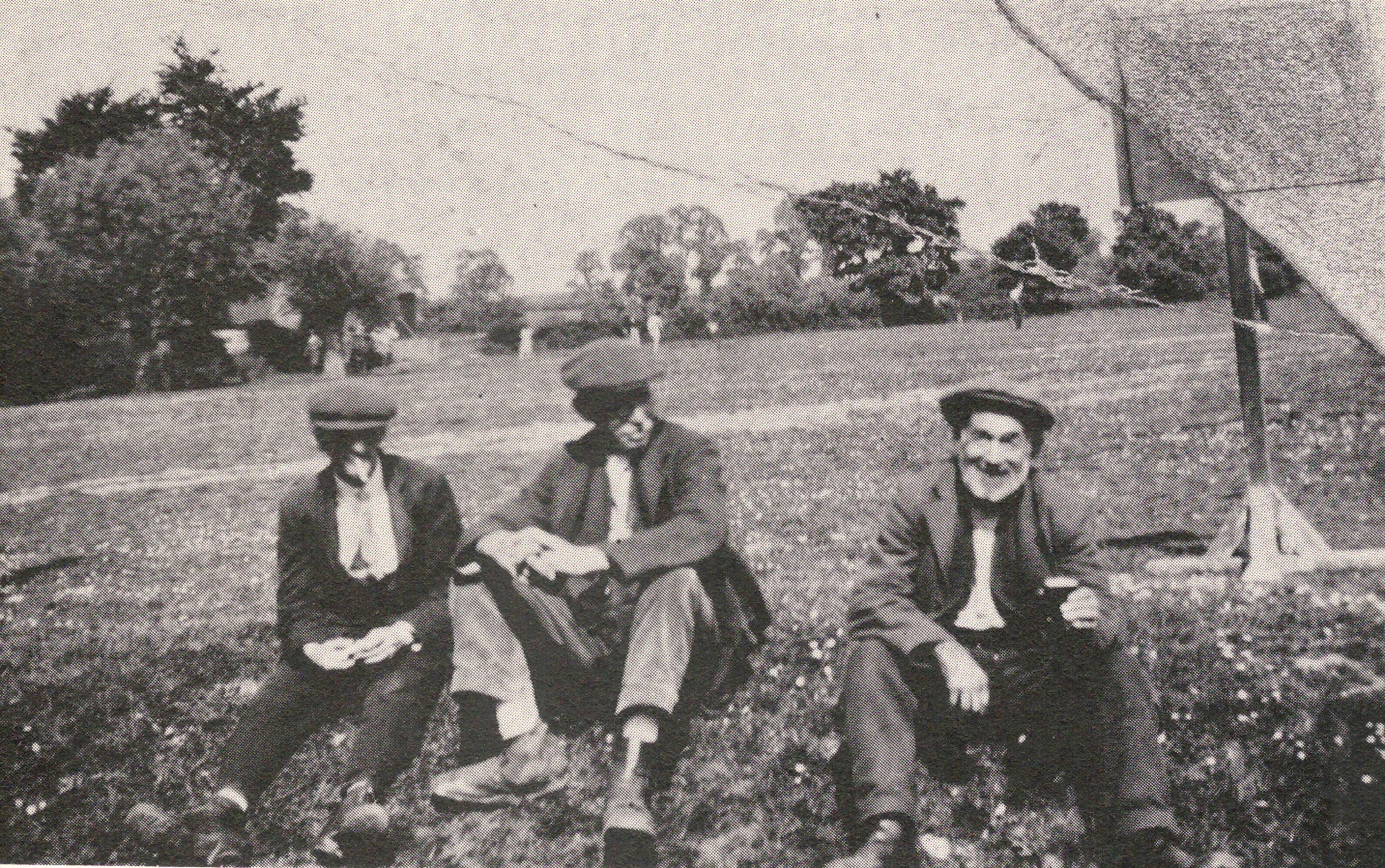
Enjoying a match on the Green!. Left to right: Bill Gaff, Jack Hedgecock (or Hitchcock), Thomas ‘Grandad’ West. Photo taken before 1937
During World War II, the pond outside Inholms was filled in, for security reasons. This pond was always full of frogs in spring, and they were seen migrating down Frog Grove Lane in large numbers: most locals believe that this phenomenon is the origin of the name of the lane. But this is not so—the original name was Forgrove.
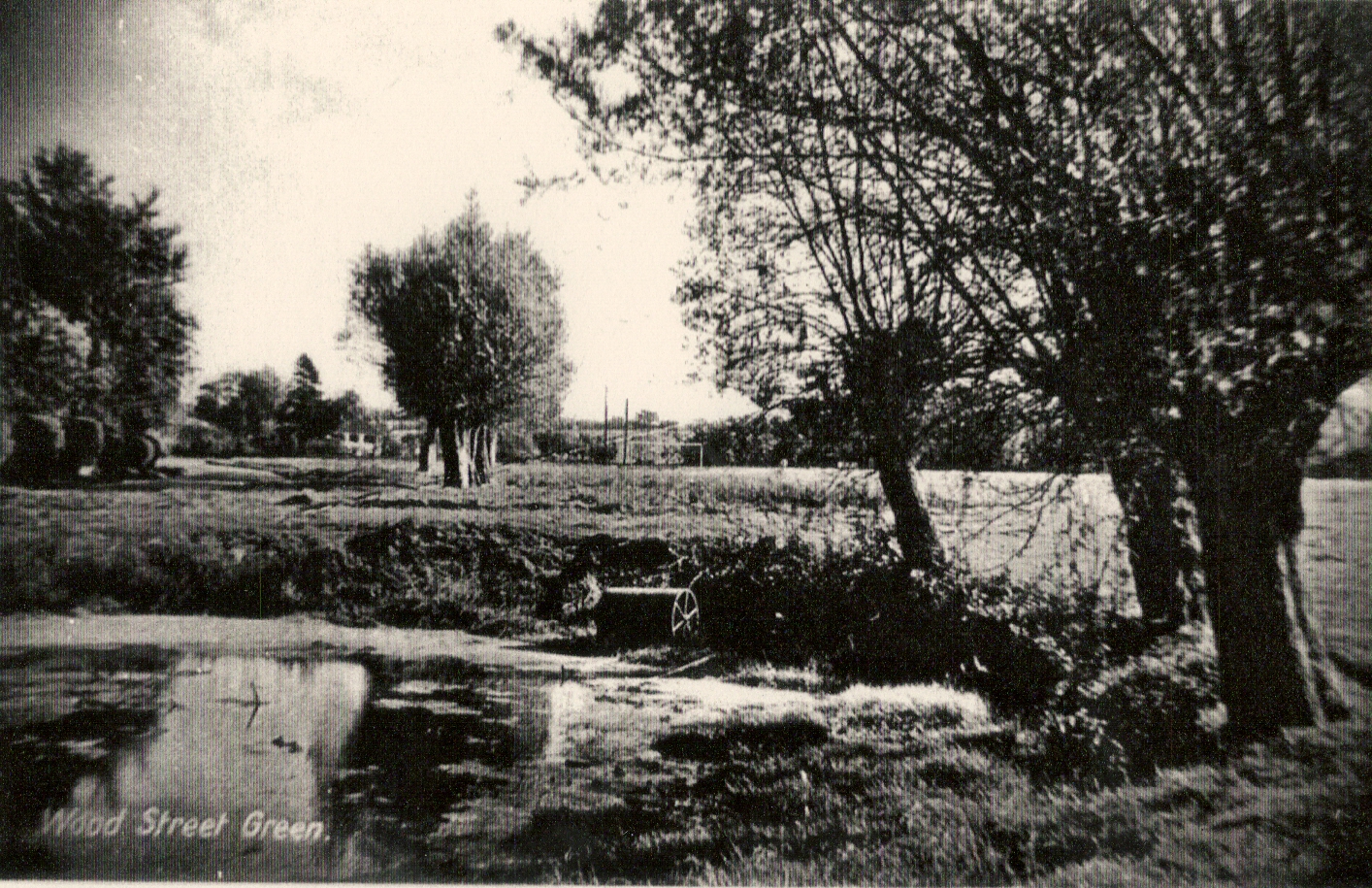
The pond on the Green outside Inholm’s Farm. This was a favorite place for frogs in the Spring. It was filled in during the war for security reasons. The willow saplings now planted in the area are reputed to come from these trees. The 1871 Maypole can be seen in the distance.
In July 1953 a village sign was erected by local people out of the residue of the Coronation Fund. There had been a competition for the design, and all the work was done by Wood Street craftsmen. The photograph on the back cover was taken in about 1955 and shows how long the grass grew without the services of grazing cattle. Wood Street Cricket Club (wsvcc ) now maintain the Green in its excellent condition. ( wsvcc have since moved to Backside Common 1991 )
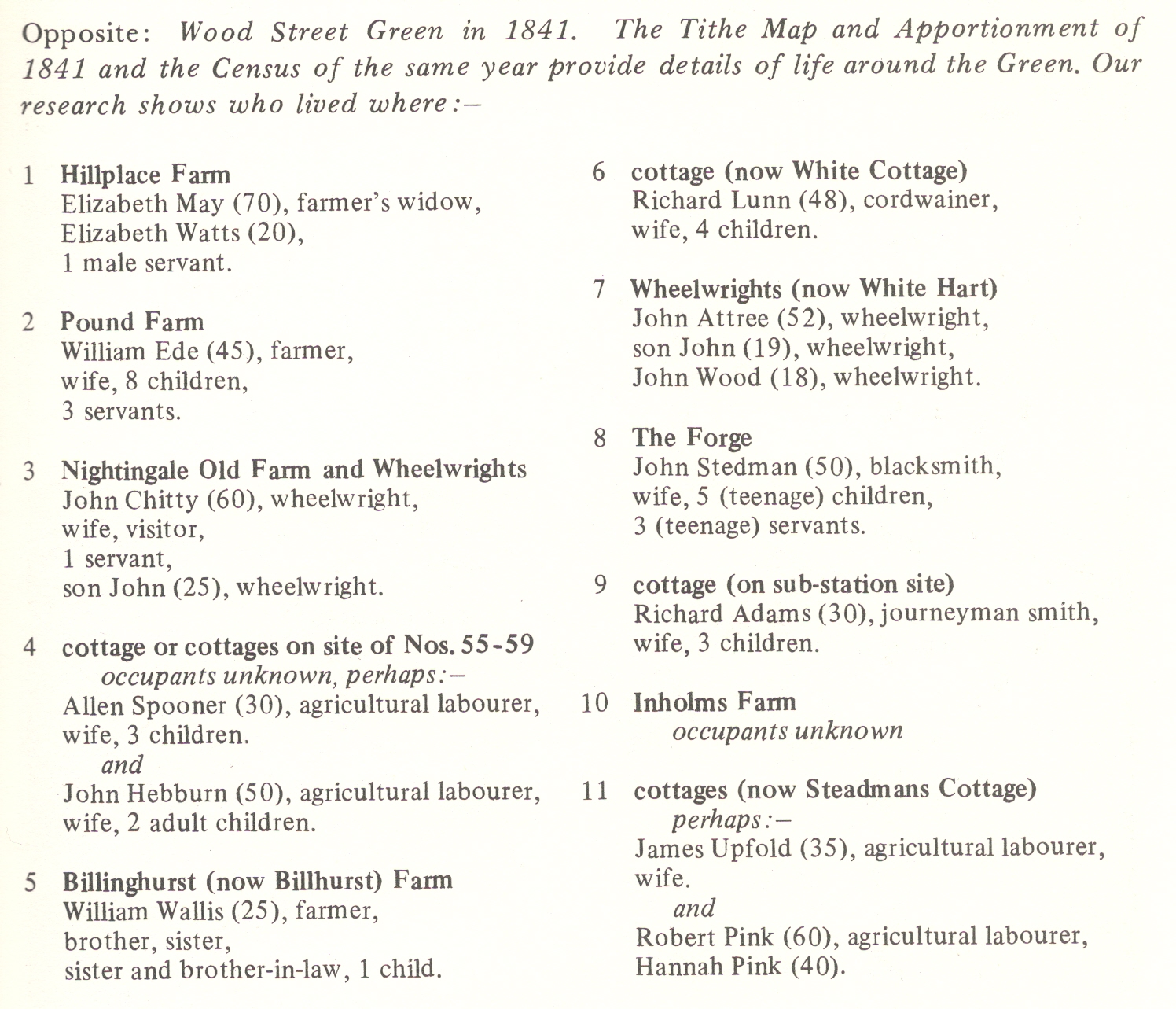
Map of Wood Street Green in 1841
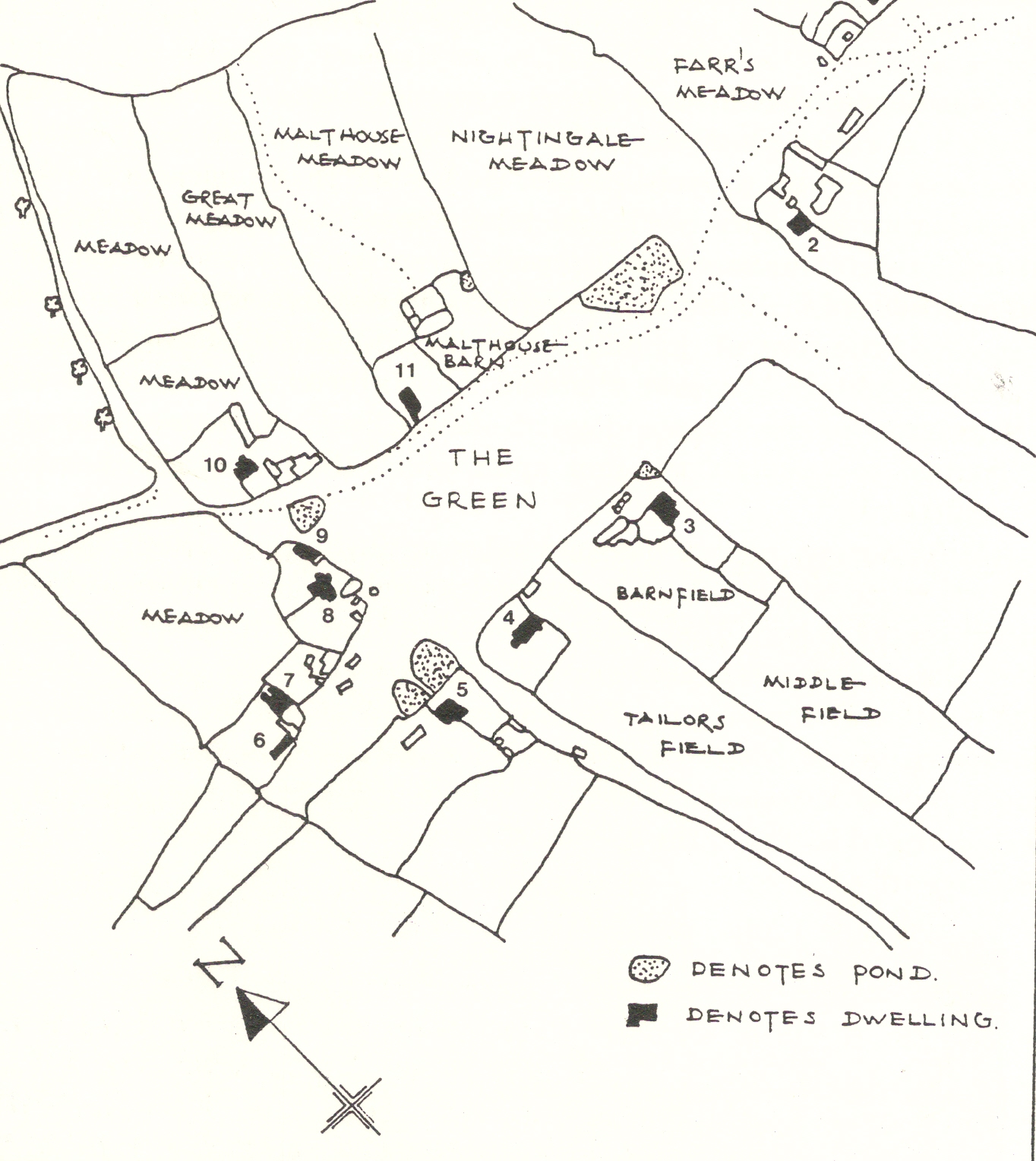
1841 Census information showing who lived around Wood Street Village Green