The Parish Church for Wood Street Village is, of course, St. Mary’s, Worplesdon, the joys and tragedies of life being celebrated there as recorded in the parish records. A large parish, and especially one with a frequently absentee Rector, is likely to allow unhindered growth of Nonconformists. This happened in the seventeenth century, when our tithing was the home of one of the first members of the Society of Friends (Quakers). Stephen Smith, a personal friend of the founder, George Fox, owned Whites Farm on the very boundaries of modern Wood Street Village. Fox stayed with Smith in 1677 and held a very large meeting in his house.
Stephen Smith gave a farm as a burial ground for Quakers. In 1739 Worplesdon Ouakers joined to Guildford: the farm was sold some years later and is now known as Fairlands Farm.
Legends about Quakers abound in Wood Street. Anglicans were encouraged to abuse Quakers in any legal fashion, and the Quakers noted incidents such as rough-musicking and damage to their houses in their records. This is probably the root of the enmity between Perry Hill residents and Woodstreeters, which was still evident in 1940.
It is popularly believed that Chapelhouse Farm (demolished and rebuilt in 1921) was once a Quaker meeting place. There are stories of people walking barefoot from Compton, carrying their shoes, in order to be clean shod for worship. The farm was once owned by Thomas Pink and was called Pinks Hill Farm. However, a conveyance of 1870 states that the farm was “now more commonly called Meeting House or Chapelhouse Farm”. The Reverend William Henry Parson had acquired it with Thomas Collins (who had since died) through the will of Thomas Pink. This suggests that Thomas Pink had bequeathed it as a Meeting House. Certainly there is no record of Thomas Pink’s burial in the parish church but, sadly, there are no records of a Worplesdon Quaker Meeting House of this period.
There was also a settlement of French Protestants—Huguenots—in Worplesdon. They would have arrived in England in about 1685. The blanket mill at Rickford and the barn for wool storage at Perry Hill are both attributed to their occupation. An elderly Perry Hill resident, writing in 1945, stated that the blacksmith of his childhood claimed to have slept in Huguenot blankets when apprenticed to John Chitty at Wood Street.
There are those still living in the area today who believe that they are descended from these Huguenots: the Boyer and Marshall families of the 1920s told their children that they were descended from the Boyer and Mareschal immigrants.

Frog Grove House. The seventeenth century part of this house may have been home of local Huguenot immigrants. An eighteenth century Sun Crest ( fire insurance ), the only one in the village, is still to be seen over the front door.
The most convincing evidence of Huguenots is the fireback found in Frog Grove House during some renovations. It contained the coat of arms of the Compte de Paris, the Pretender to the French throne who was supported by the persecuted fleeing Protestants. In the 1930s the BBC researched a similar fireback found at Wood Norton: they claimed that a large clan of Huguenots was established in Pirbright, Normandy and Ash. (We should perhaps remind ourselves that all reporters at this time persistently and ignorantly regarded Wood Street as being part of Normandy.)

The Coat of Arms of the ‘Compte de Paris’ on the fireback in Frog Grove House. French Huguenots favoured the Compte as the French King in the hope of relief from religious persecution.
Others in Wood Street were active in their support of the Parish Church. William Wallis, of Billinghurst (Billhurst) Farm, was one of the nineteenth-century Churchwardens. Three successive occupants of Littlefield were also Churchwardens, but we are pleased to note that no Woodstreet resident was on the committee appointed to “carry out the proposed alterations and improvements to the Parish Church” in 1866. Indeed, the interests of Wood Street residents were so ignored that the grave of James May (d. 1834) of Hillplace was amongst those desecrated by the improvements.
The Vestry, the forerunner of the civil Parish Council, was run from the Vestry Room. John Stedman (senior) and John Chitty (wheelwright, senior) acted as overseers for the poor of West End Tithing for many years. The owners of Littlefield, Whipley, Billhurst, Nightingales and the forge all took their turn as Waywardens. George Stedman was a Parochial Constable for a total of thirteen years.
It was in the minds of these men, perhaps even as they warmed themselves around the village forge, that the idea of a church for Wood Street began to take shape. The presence of a separate school for Wood Street had furthered the concept of a separate ‘village’, and services were held there from the earliest days. (In 1901 the Schoolmistress was allowed to live in the house rent free in return for giving religious instruction in the school on Sundays.) A fund was set up in 1893, entitled ‘The Wood Street Mission Fund’. Perhaps the title reflected the way the initiators felt about the souls of Wood Street! Two pounds and nine shillings, for example, came from a special offertory at a service in St. Mary’s on 26th November 1894.
The Parish Council Minutes of July 1914 state that “a letter from Smallpiece & Co. was received, enclosing a copy of an application to the Board of Agriculture for their consent to enclose three-quarters of an acre of the Common in Wood Street. The application was in connection with the proposed new Church at Wood Street, the Lord of the Manor having previously given his consent.” There is no record, however, of permission being granted or of further action.
A definite decision to build a “Church Room or Hall” in Wood Street was again taken at a meeting of the Worplesdon Parochial Church Council (P.C.C.) held in Perry Hill School on 26th November 1921. The initiative came from the Wood Street Social Committee, on which Capt. and Mrs. Abbot of Inholms Farm were leading lights. Mrs. Abbot, who was on the P.C.C., urged that the proposed building be suitable for a library and for “general village purposes”. The ex-servicemen of the village offered a sum of twenty-five pounds towards the building. The 1893 fund had been joined by two others, the total now being one hundred and ninety-seven pounds. The P.C.C. resolved to erect a church building with a sanctuary that could be partitioned off when the ‘room or hall’ was used for purposes other than worship; the Wood Street Social Committee (sometimes referred to as the Wood Street Sports and Recreational Committee) was to be consulted about a suitable site.
It was not until nearly three years later that the Wood Street Social Committee recommended to the P.C.C. the purchase of “a site opposite the Royal Oak for the erection of a Mission Hall”. On 11th October 1924 the P.C.C. empowered Mr. Narroway (Beckdale House) to obtain the site from Mr. Steer, a confectioner and tobacconist, at a cost of one hundred and forty pounds.
In the meantime, efforts continued to raise funds for the new building, both in inviting subscriptions and in organising events. The Parish Magazine of November 1924 advertised “A Working Party” to be” held on Tuesday each week at the Hut on Wood Street Village Green, at 2.30 p.m. Work will be provided. A charge of twopence will be made, and a cup of tea and cake will be provided. The object is to provide goods for a small sale of work, the proceeds of which will be devoted to the Wood Street Mission Building Fund.” It seems that services in the Wood Street School had lapsed, because they were reintroduced on 16th December 1923. The Rector, the Reverend J. C. G. Bruce, took the first service, which was attended by some fifty people. Captain Wallis of the Church Army, a licensed reader, was appointed in 1924 as full-time missioner for Wood Street. He gave the village “three years’ faithful service”.
“A design for a timber and asbestos building with corrugated iron roof and brick and concrete foundations” was presented to the P.C.C. on 7th February 1925. The design, by Mr. Dauber, was contracted to Messrs. Tribe & Robinson, who built the Mission Hall in nine weeks. The cost of the building was six hundred and forty-three pounds; heating apparatus was installed a year later for seventy-six pounds nine shillings and sixpence. The dedication of the Wood Street Church Mission Hall took place on Saturday, 20th June, 1925.
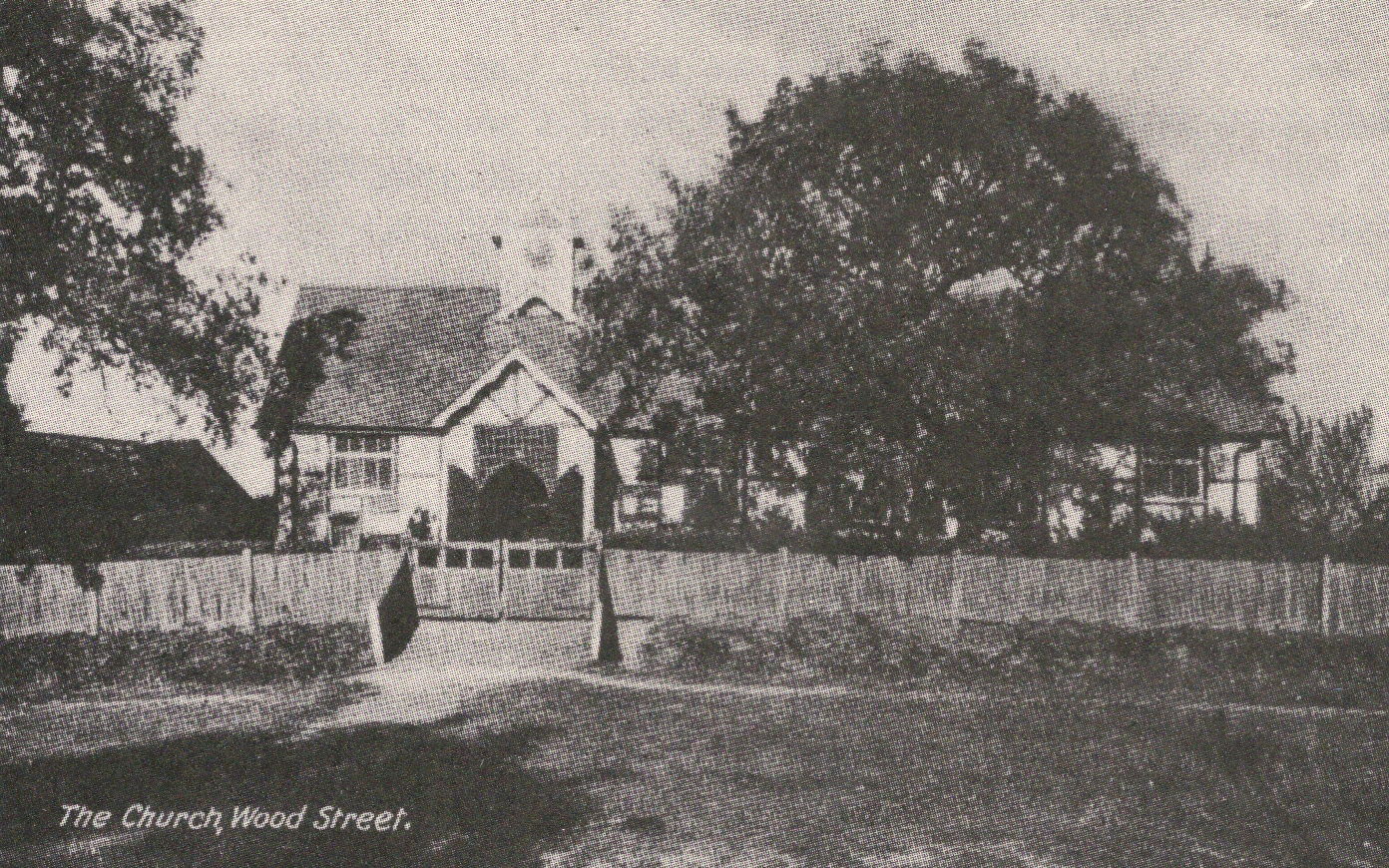
Wood Street Church Mission Hall. Some say that it was not a church at all, but merely a hall with a stage at one end and curtains to shut off the sanctuary during secular activities. The foundations now act as the base of the Church car park.
The P.C.C. had rented Old Gables for Captain Wallis at a cost of fifty-two pounds per year. He left on Lady Day 1927 when the lease expired. The Rector had written to Church Army headquarters that “owing to lack of accommodation the services of Captain Wallis must terminate on March 25th.” His departure left such a gap that within months the P.C.C. had decided to build a house for a priest on land lying to the north of the Mission Hall, a ceiling of one thousand two hundred pounds being placed upon building costs. The first occupant of that house was the Reverend Elliot Ostrehan Iredell. The newly-created Diocese of Guildford had set the stipend for assistant clergy at two hundred pounds per year, so the P.C.C. decided to pay him two hundred and fifteen pounds per year, in order to cover the fifteen-pounds-a-year rates on the house. The Diocese wrote to object to this irregularity, a curate being overpaid! The angry and astonishing response of the P.C.C. was to increase his stipend to three hundred and fifteen pounds! The Rev. Iredell must have felt truly blessed, since his former salary as Rector of Chilbolton in Hampshire was only fifty pounds a year. It is hardly surprising that when the time came for the curate to move on there were seventy-two applicants for his position.
The 1925 building was known as the Church Hall or the Mission Hall until 1937. On 23rd February of that year it was rededicated as St. Alban’s Church. It is popularly believed that the church was named after the Wren Church of St. Alban in Wood Street, London (bombed in 1944). Only eight months after the rededication the curate announced that he was convinced that a new church was required. The vision of Curate Bell took thirty years to realise: the present St. Alban’s Church was dedicated on 22nd December 1967 by Bishop Reindorp. The design by David Nye, diocesan architect, was built by Messrs. Jackson & Gocher and the cost was sixteen thousand, three hundred and twelve pounds, seventeen shillings.
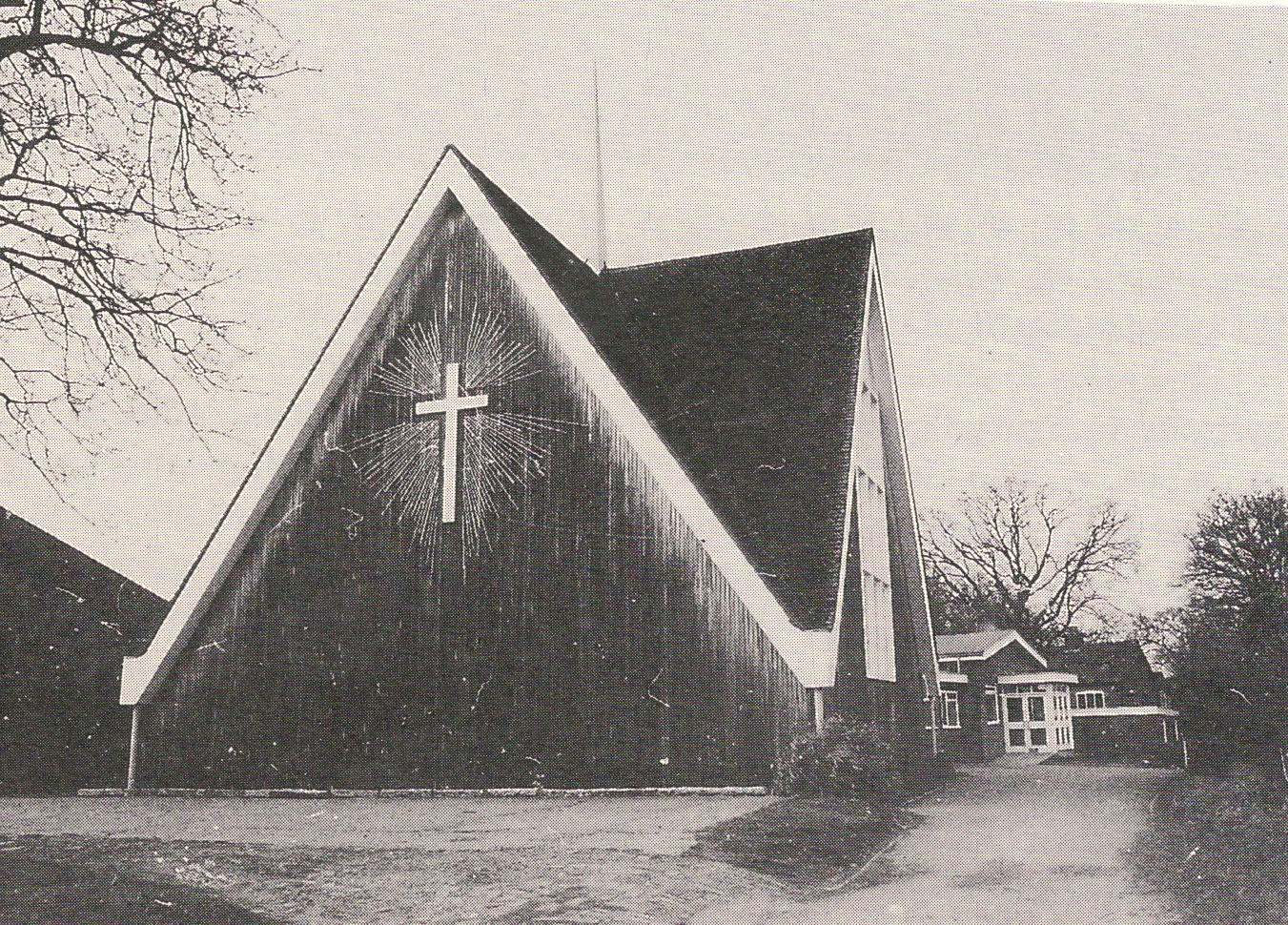
St. Alban’s Church and Hall. The decorative cross was made by students of Farnham College of Art and erected in 1981. The Narthex acts as an entrance to both the Church and Hall to signify the importance of the Church in everyday life. The library, part of the nineteenth century vision, is maintained here too.