The first known shop existed before 1877. Groceries were sold from a small room at the back of the White Hart. The young conscripts of 1916 sent the children of the village from the mustering point on the Green with pennies to buy sweets there. In 1899 Benjamin Potter owned a cottage shop at 4, Broad Street Cottages (now 70, Broad Street) and later there was one near the Hare and Hounds public house, which closed in the 1960s.
The first reference to a post office appears on a map of 1870. It seems that George Stedman, the blacksmith, took on yet another public service, and successive blacksmiths advertised themselves as sub-postmasters. By 1914 the post office had removed to the north side of the pair of cottages which now form Willow Cottage on the Green: Mr. Arthur Brown and then, after his call-up, his wife Alice ran it in conjunction with a small shop. By 1922 it was run by Mr. Boyton from the south side of the Green. In 1927 Mr. Woodhams opened the post office in a wooden hut next to the present post office; Ernest Grinstead moved it into the house when he took over. Mrs. Ethel Crick was the village post-woman from 1926 until 1947. The mail was delivered to Wood Street, whence she delivered it on a four-and-a-half-mile round. She had no official uniform, merely a hat and armband.
Next to the present post office, on the site of Wealden Court, was a haberdasher’s, run for three decades by Miss Goodchild. From 1965 it was run for a short time by Mrs. Bayliss, but it was sold in about 1969 and later redeveloped.
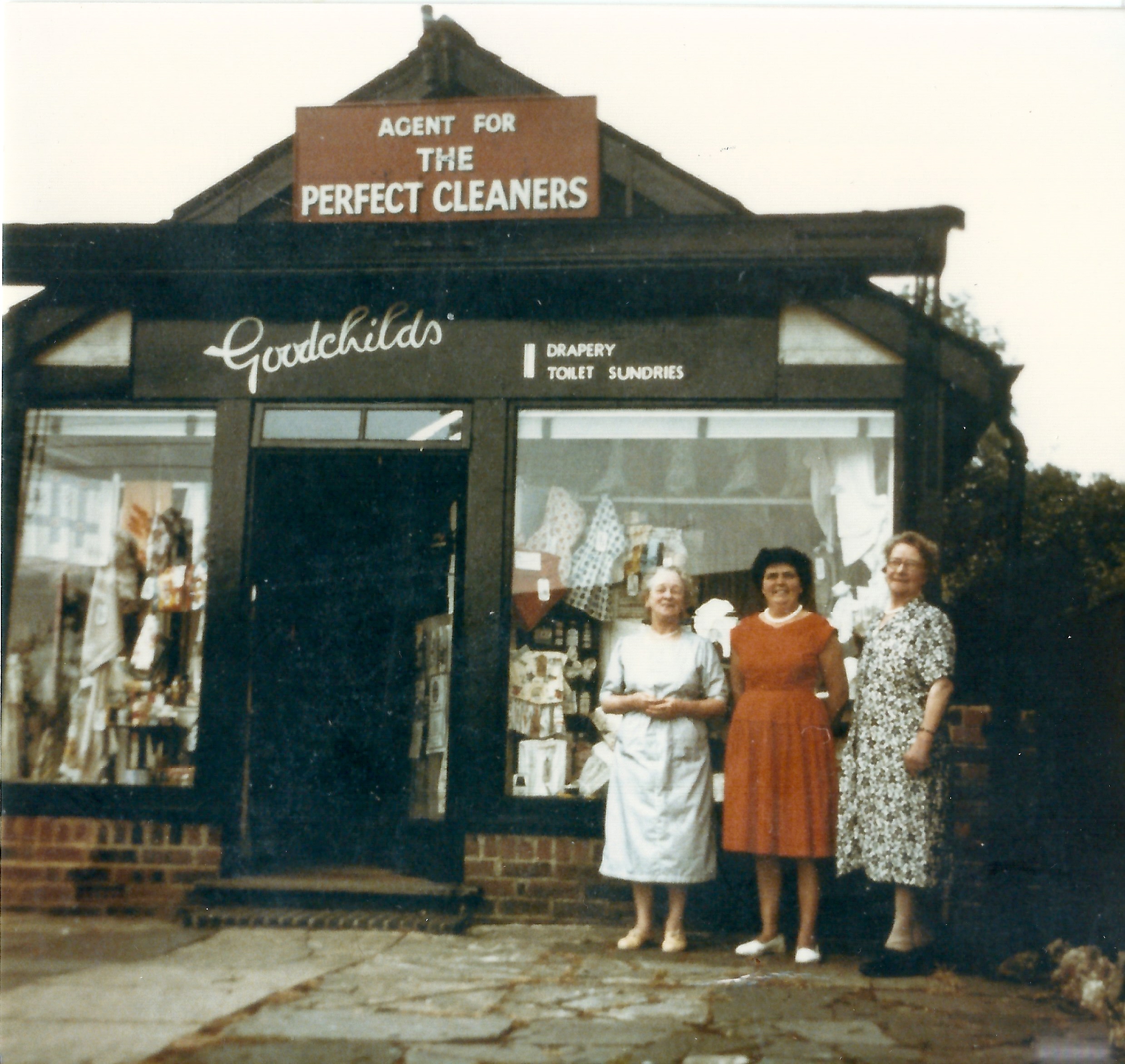
Miss Goodchild’s haberdashery shop as many remember it. Miss Goodchilds stands on the right, with her two assistants: her sister-in-law , Mrs Goodchild (left) and Mrs Gardner (centre). ~1940
Hillbrow, the house which stands between New House Farm Lane and the school, was once used as a second-hand clothes shop. Between the wars Mr. and Mrs. Hammond (née Mitchell) ran a fish and chip shop there.
Jubilee Stores was built in 1935 as a small grocery store. Both village shops stand on land owned by the Hester family, who own all the land occupied by traders in Oak Hill. The garage was started as a couple of petrol pumps for one of the Hester family and developed in the 1960s by Jack Lyons.