Nineteenth-century parish roads were maintained and repaired much as they had been for the previous three hundred years. Flint was dug out in the area between Hollybush Farm and Pound Lane and carried to the roadside, where it was broken up. Getting to Guildford by carriage had been much improved in the late eighteenth century when the Rector of Worplesdon built up a causeway to the Wooden Bridge. The General Highways Act of 1835 relieved individuals of the task of actually working on the roads for a set period each year. Much of Wood Street’s flint went elsewhere, since the road to Wood Street petered out at the Royal Oak and deteriorated into a rough track as late as 1920.
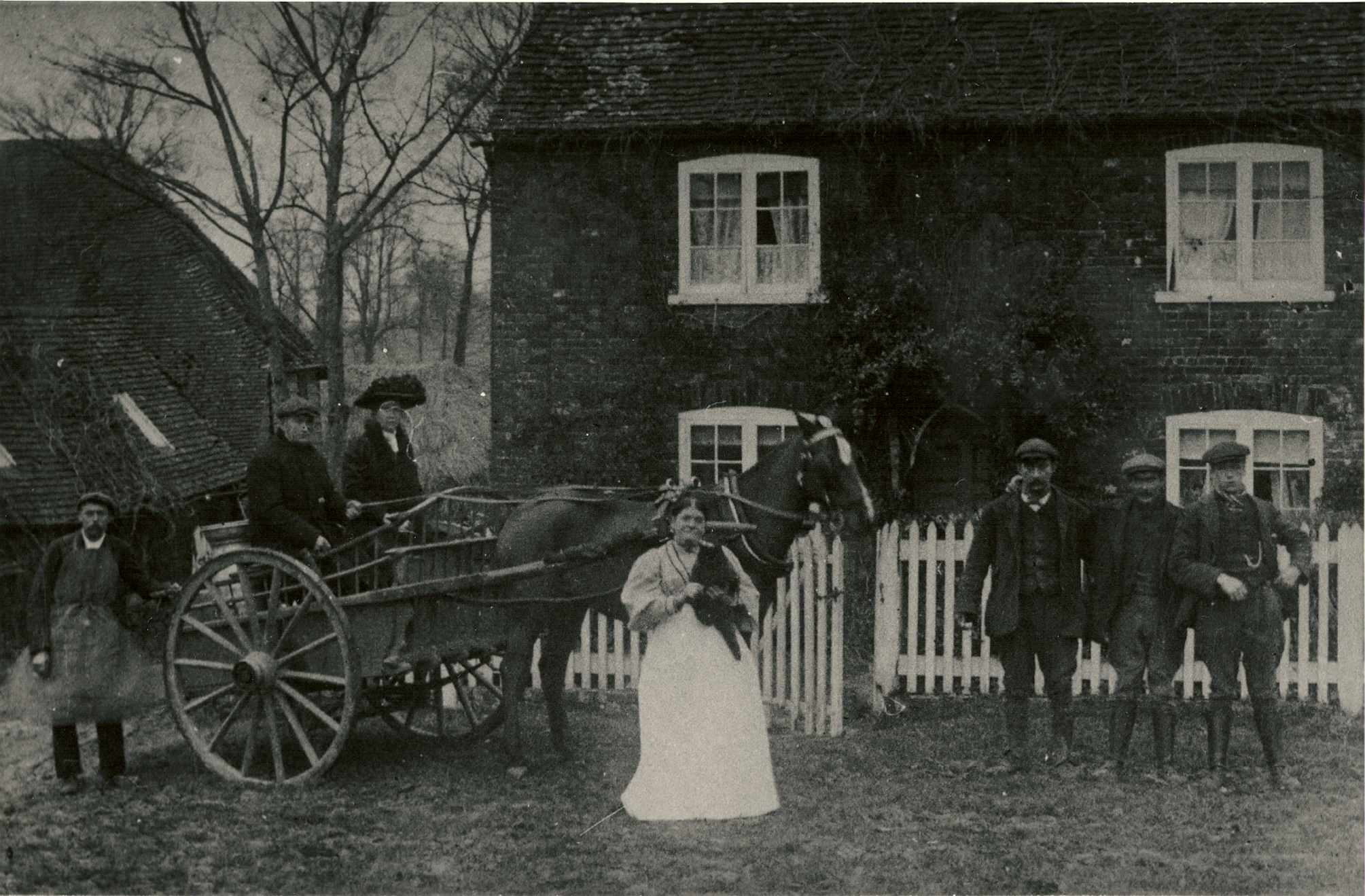
The Cousins Family Trap outside Hillplace Farm: Elizabeth Cousins nee Hall (centre) with Walter (cud) and George (shep) Cousins (on the right).
There were occasions, such as in 1853, when the Vestry did consider “whether the road from Frog Grove and Woodstreet Road to Russell Place Farm should be made up or not”. They decided against it. The Vestry, formerly responsible for road maintenance, disliked the new system so much that they were unanimous in condemning it in their reply to a Government questionnaire of 1869. In 1873 Worplesdon Vestry members were the moving force behind the dissolution of the Guildford Highway District Board and then in the chairmanship of the new Highway Board. Improvements were not enough and the poor state of the roads was reported again in 1880.
If the Vestry was exercised over roads, their patience was exhausted over the railway. No part of the parish benefited from it (Worplesdon Station was built much later). Negotiations over the rates continued for twelve years, and they were finally settled in court. The railway through Wood Street was opened in 1849: the peace of the village was shattered, with the advantage of just two residents gaining employment. A signal box was later built beneath Pinks Hill Bridge, subsequently being replaced by one at Pound Lane called Pinks Hill Crossing. A cottage for the signal-man was built there too.
There was much local and national amusement in 1964 when British Rail closed Pinks Hill Crossing: they provided an access road for use by the owner of Wildfields Farm at a cost exceeding the value of his property. The signal box and house were demolished soon afterwards.
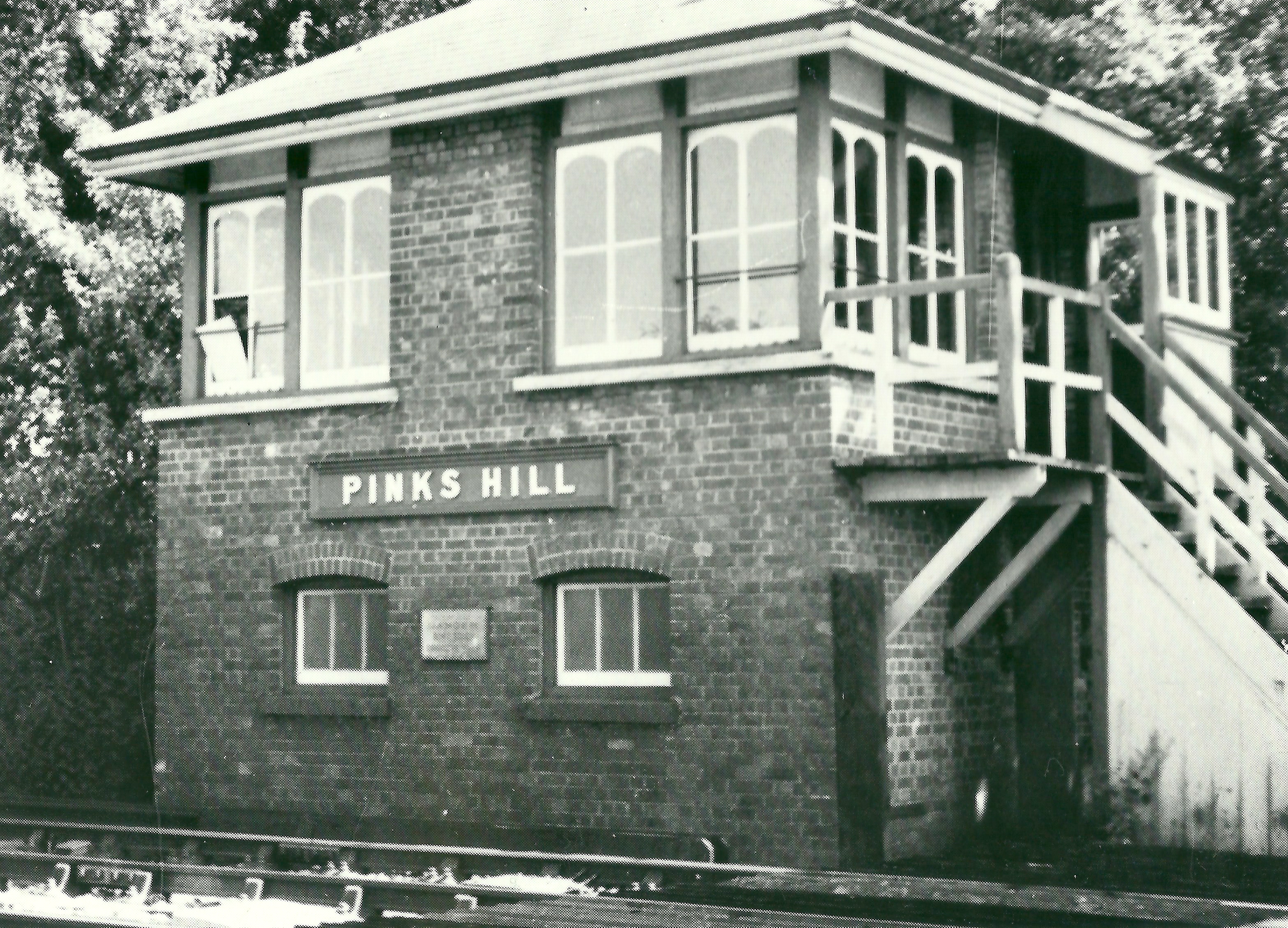
The 1915 Pinks Hill Signal Box at the end of Pound Lane, a typical railway building. The signalman, Ben Mitchell, lost an arm in a shunting accident, but still managed to do gardening, shoe repairing and other odd jobs in order to support his large family.
Footpaths were a problem to the Vestry and continue to trouble the Parish Council. The clay soil frequently caused breakdown, and paths were often churned up by the Hunt.
The first regular transport to Guildford was by carrier’s cart; Hobbs, the carrier, merely extending the idea of the traditional lift given as part of his delivery service. People still remember that the cart had a big white canvas top. It is said that later he put a few wooden forms on a lorry used for carrying coal and other merchandise. Mr. Hobbs was still in business as a carrier in 1930.
The Blue Bus Service was the first autobus service from Wood Street to Guildford. The depot was at Stoughton Road, and the driver was Mr. T. Denton, who lived in Wood Street. The last Saturday night bus from Guildford was always so overcrowded that the engine would not pull up Woodbridge Hill; the male passengers were obliged to get out and push. The owner, Mr. Crouch of Stoughton, also had a taxi service, for which he used a taxi and a hansom cab. These were popularly referred to as ‘Crouch’s Funeral Car’.

The Blue Bus with driver Mr Denton of Wood Street Green.
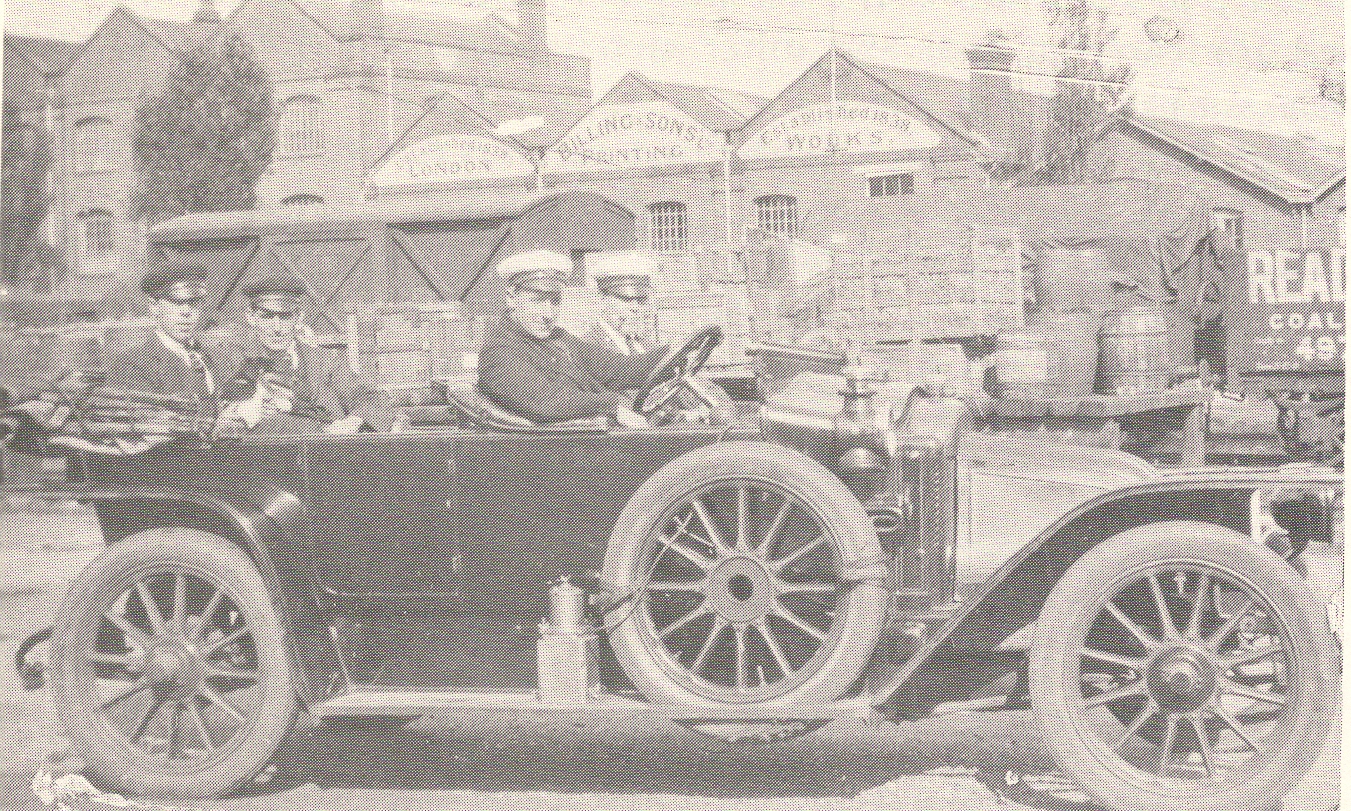
Crouch’s Taxi with driver Harold ‘Bunny’ Johnson at Guildford Station.
In 1928 Messrs. Hutchins & Hayter put two Dennis vehicles into service between Guildford and Camberley via Wood Street, in the livery of their Yellow Bus Service. The service provided ten return journeys on weekdays, with an extra journey on Tuesday mornings. On Sunday mornings there was a short journey from Wood Street Green at ten-thirty, returning at twelve-thirty. Late theatre buses ran on Tuesdays and Saturdays to Wood Street Green.
It was not unusual to see the extra Tuesday bus carrying crates of chickens on their way to market.
In foggy weather the conductress would walk in front of the bus to guide it with a torch; a passenger volunteered to guide when the bus became one-man-operated.
The Yellow Bus Service was withdrawn in 1954 when Aldershot and District Company took over the route.
The first car in the village was reputedly a Dion owned in 1910 by Mr. Cheeseman of Frog Grove House.