A voluntary school was established at Wood Street in 1878 by a committee under the chairmanship of the Rev. George I. Dupois “to make best use of the provisions of the Elementary Education Act (1870) for furthering the education of the people of this parish”.
It was first intended as an infants’ school for eighty children, to complement the already-established school at Perry Hill. When the proposed school neared the drawing-board stage, however, the Inspectors decided that it should be a full school for fifty children. There was to be one school room, and living accommodation for the teacher.
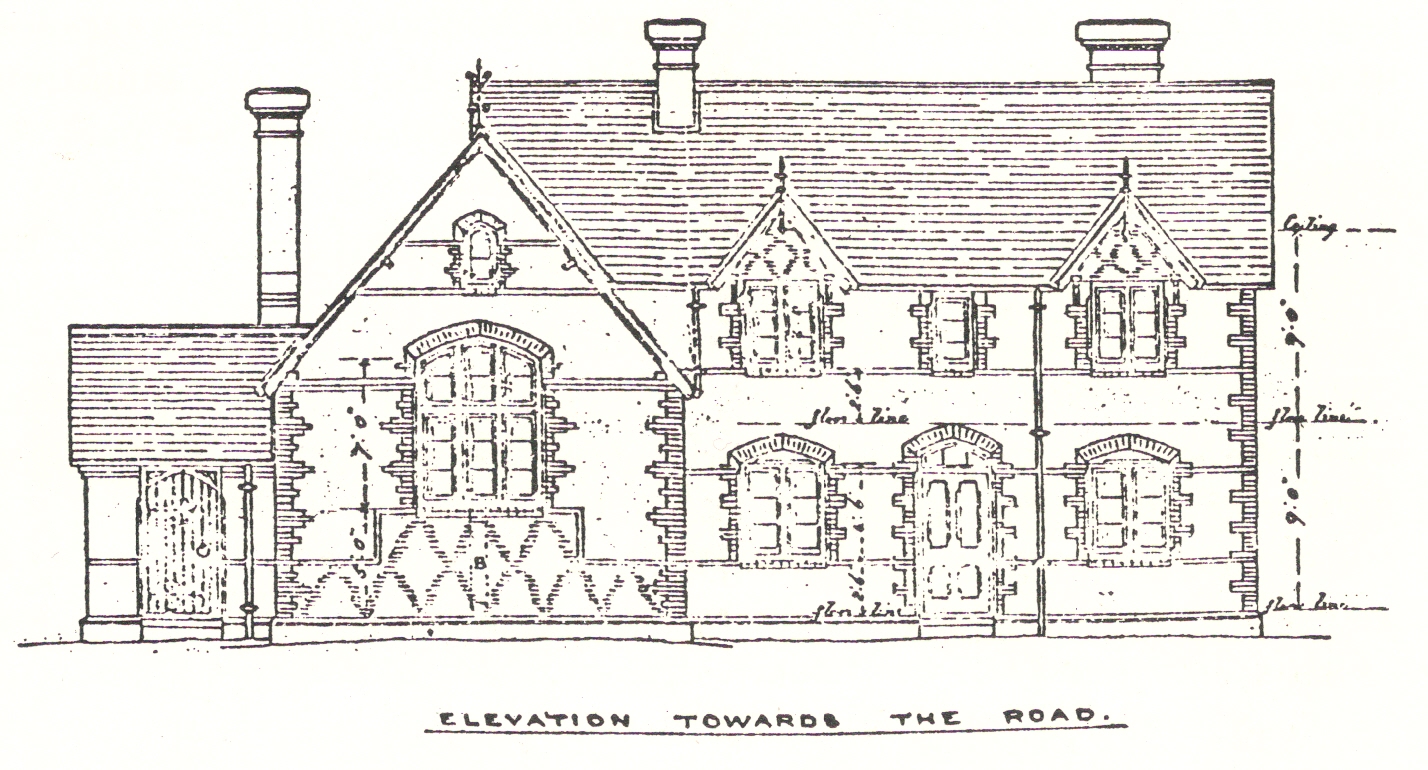
The View of the proposed school from the road – 1872
In 1872 Henry Peak was commissioned to draw the plans. He was a very prolific architect and is said to have been “the Architect of Victorian Guildford”: he was responsible for many of the buildings in and around Guildford between 1864 and 1891. The school was built by Thomas and John Loe, Builders—but also owners of Old Gables and Chapelhouse Farms—at a cost of four hundred and fifty-three pounds, with a grant of thirty pounds from the National Society.
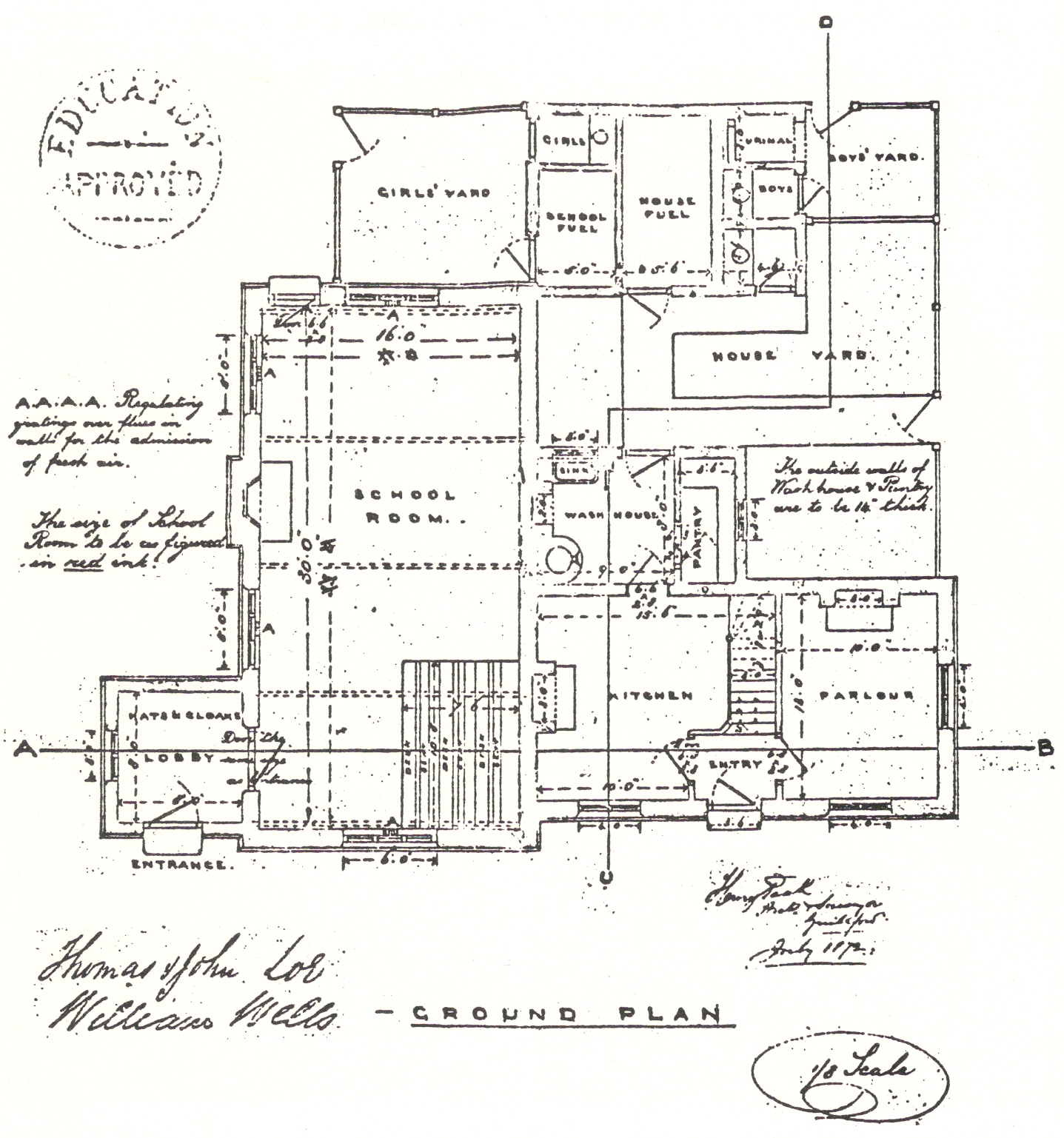
Henry Peak’s plan for the school (1872). Courtesy of Surrey Record Office. Reference 264/43/1-5.
In the early years the school was supported by the rich of the Parish of Worplesdon with a rate levied by the Church. The parents also had to contribute by means of the ‘school pence’.
The school was opened on 8th April 1878 with an intake of eighteen and by July there were forty-six pupils. For many of the children it was their first schooling, but others came from a class held by Miss Keel in the chapel (now a private house) opposite the ‘Cricketers’ on the Aldershot Road, and from the main school at Perry Hill.
In 1882, when the school became a Board School, an announcement in the Surrey Advertiser stated that the new school board “Resolved to carry on the existing schools at Worplesdon [Perry Hill] and Wood Street under the existing arrangements until Michaelmas, the present teachers to be notified accordingly, and the new arrangements will be entered into from that date. Also that the trustees of the present school [the Worplesdon Church] be asked to state upon what terms they will grant the use of the present school buildings, and the Board are desirous the Wood Street School should be made a public Elementary School.”
As a Board School it relied on an annual grant from the Government, which in turn depended upon a favourable report from the Inspectorate. The grant in 1891 was 12s. 6d. per child, with extras for:– discipline, 1s. 6d.; singing, 6d.; English, 2s.; girls, 1s.; giving a total for that year of thirty-one pounds eleven shillings and sixpence.
By 1882 the ‘school pence’ had gone up to 3d. a week but only 2d. for each extra child. If the parents were wealthier they were asked to pay 6d. a week. The teacher (usually a Miss) was paid approximately forty pounds per year; she had to teach all grades from infants (five-year-olds) to standard five (thirteen-year-olds). She did have the help of a monitress, who was usually a pupil who had just left school and was paid ten shillings per month.
By the turn of the century the school was getting too small and the Inspectorate insisted that a separate room be provided for the infants. After many warnings had been issued, including the threat of withholding the grant, an extension was put on the school room in 1902, which enabled the infants to be taught separately. This room now forms half of the school hall.
A surveyor’s report of 1904 shows that seventy-two children were housed in the extension (half hall) and twenty-three infants in the original classroom (attached to the house). The toilets were of hopper type with no water available for flushing (they were flushed and cleaned once a week with water carried from the house well). The cesspools were emptied twice a year, usually at night, by men with buckets.
The catchment area for the school roughly encompassed Flexford, Strawberry Grove, the ‘Cricketers’, Perry Hill and Passengers Farm. Many of the children had to come over the common land to get to the school, so very often only a few children would be able to attend school if there was flooding in the district.
The school was closed on joyful occasions, such as the Royal Wedding in 1893 of (the later) George V and Mary and in 1897 to commemorate “the Queen’s long reign” (Queen Victoria’s). It was also closed for more serious reasons, such as diphtheria, scarlet fever, whooping cough and measles.
As a school treat the children and staff would be invited out to tea with the local landowners, sometimes followed by a magic lantern show. If the trip involved any distance, such as Guildford Town or Merrist Wood, a two-horse braked waggon was ordered.
The children often helped the hospitals by going out picking black- berries on the common. They also responded to ‘Pound Day’, which involved bringing in a pound weight of any product they wished.
In 1913 a separate infants’ school was built in the mistress’s garden. This meant that the school could be divided into three groups: infants; standards one and two; and standards three to five.

Wood Street School – Mr Oyston’s class of 1918

who’s who
- Stan Burgess 19. Len Nicklin
- ? 20. Burt Grist
- Les Goodship 21. Son Pearce
- Don Buckler 23. Reg Grist
- Alec Martin 24. Annie Napper
- ? 25. Jenny Limming
- Edgar Goodship 26. Freda Ives
- Les Buckler 27. Daisy Cousins
- John Huck 28. Lance Case
- Ken Buckler 29. Alice Thompson
- Charlie Gaff 30. Rose Boxall
- Teddy Ayling 31. ?
- Alice Pierce 32. David Hill
- Olive Huck 33. David Hill
- Clara Thompson 34. M. Ayling
- ? 35. Bill Tresher
- Ernest Limming 36. Sid Boyton
- Mr Oyston
The school continued to grow and by 1928 it was felt that another extension (to the existing extension) was needed. This was built and the end wall of the original extension taken out and replaced with a wooden partition, so that the two classrooms could be used as one big room for concerts and assemblies.
The school meals service was started during the Second World War. A cooker was placed in the lobby to cook food and provide hot Horlicks, which were taken back to the classrooms for consumption. The central- heating boiler and the telephone were also in the lobby—you can imagine that there were times when it was almost impossible for the headmaster to hear the phone. It was not until 1958 that the school house (up to now a residence for the head teacher) was converted to provide a kitchen, on the ground floor, and headmaster’s offices and medical room on the first floor. Soon afterwards the flower beds at the front were asphalted over to provide more playground space.
In 1963 one of the three air-raid shelters was taken down to put up a temporary classroom. This enabled the original school room to be used as a dining room. By 1971 a second temporary classroom had been installed, and this allowed the partition between the two extensions to be removed to provide a hall large enough to hold all the school. The original school room then became a classroom once more.
Plans showing the development of the School from 1878 to 1982:
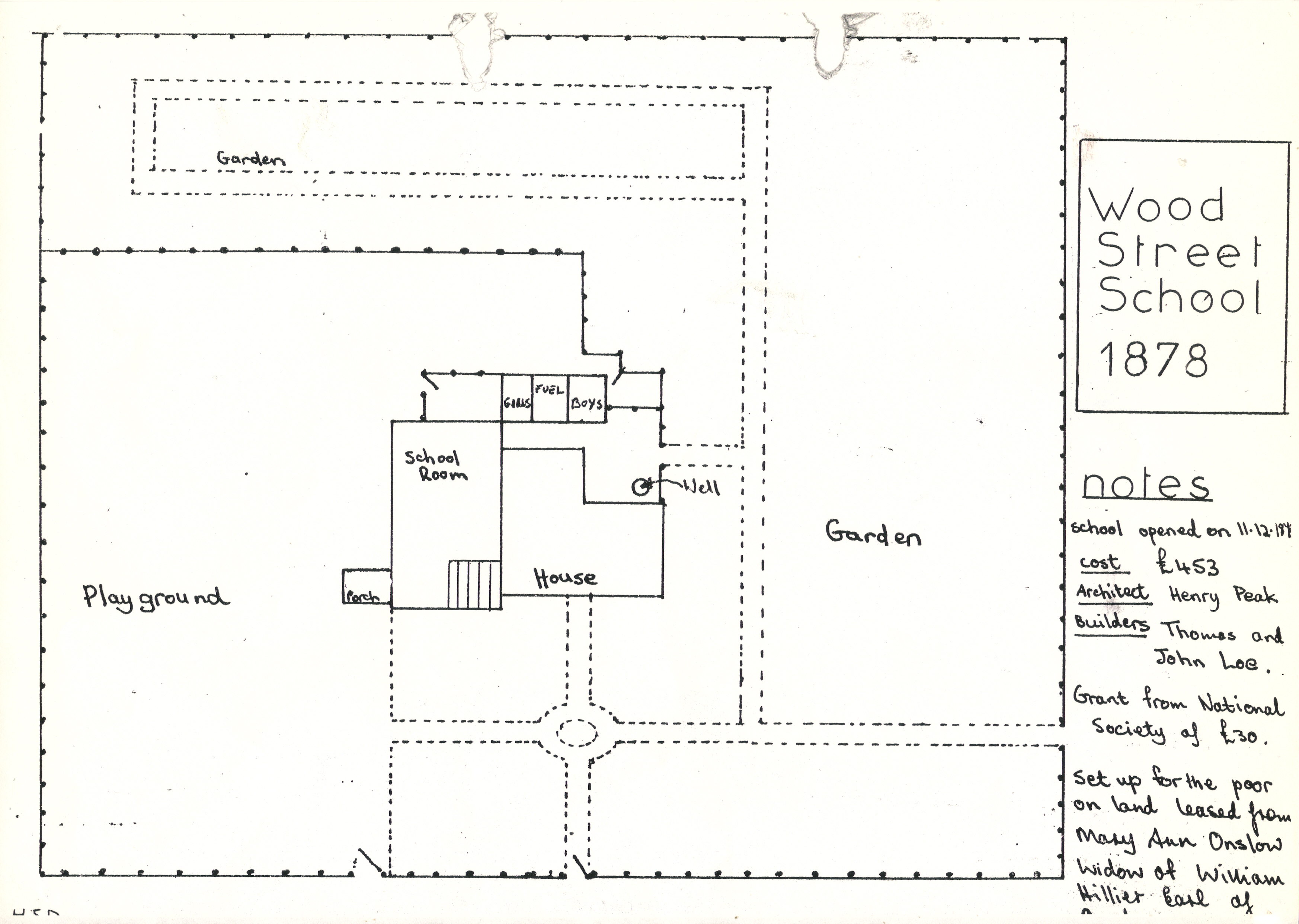
Wood Street School 1878
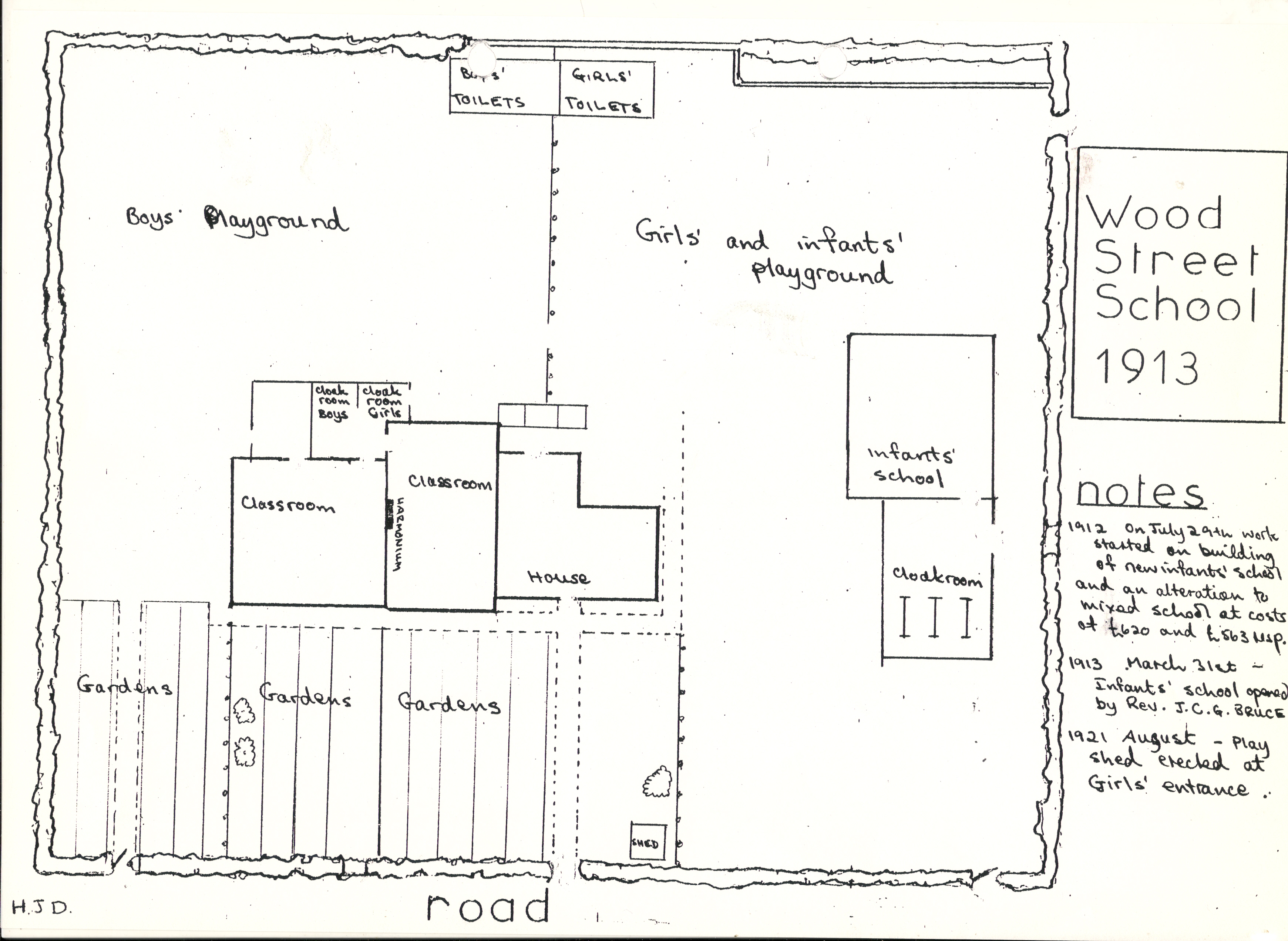
Wood Street School 1913
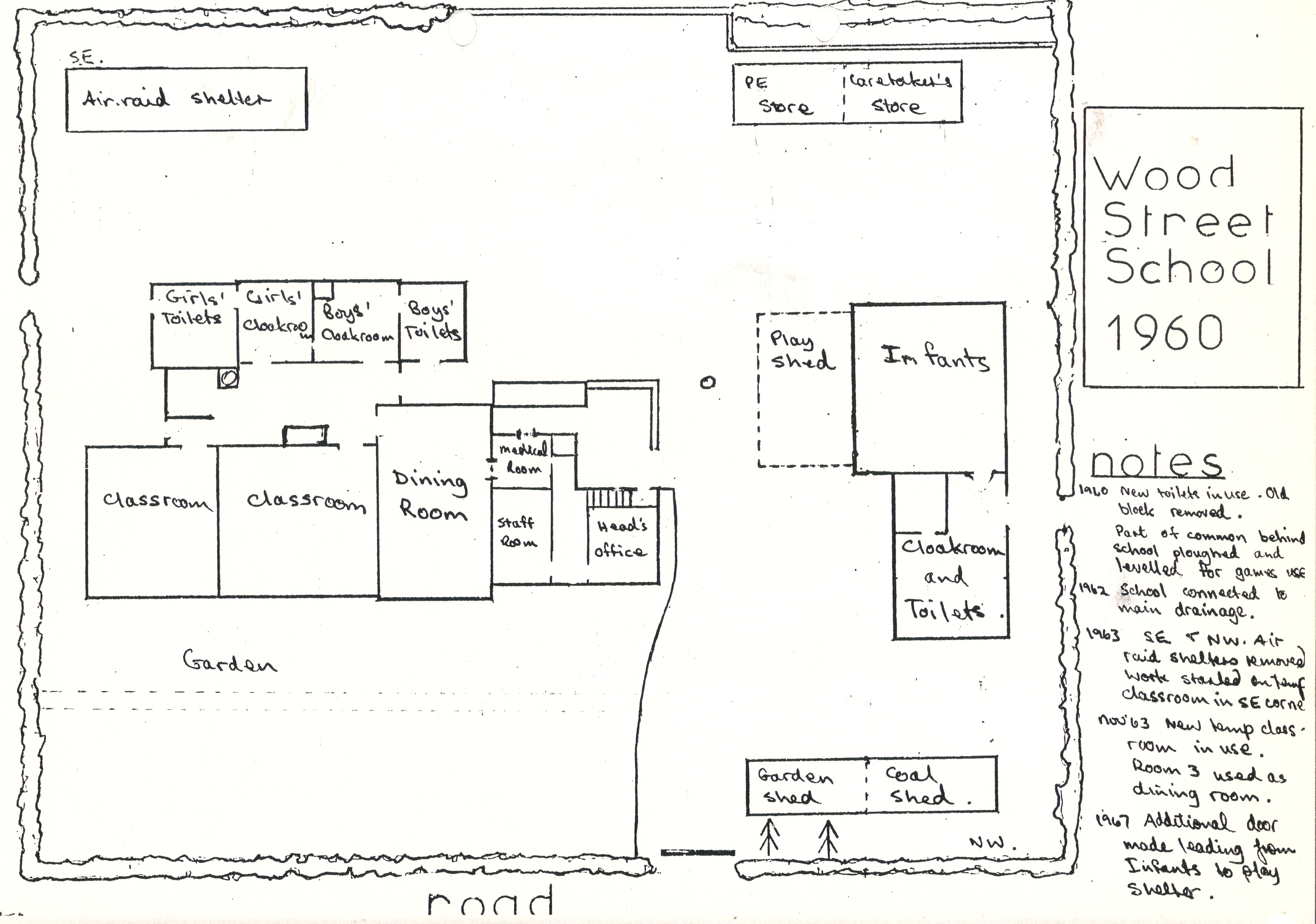
Wood Street School 1960
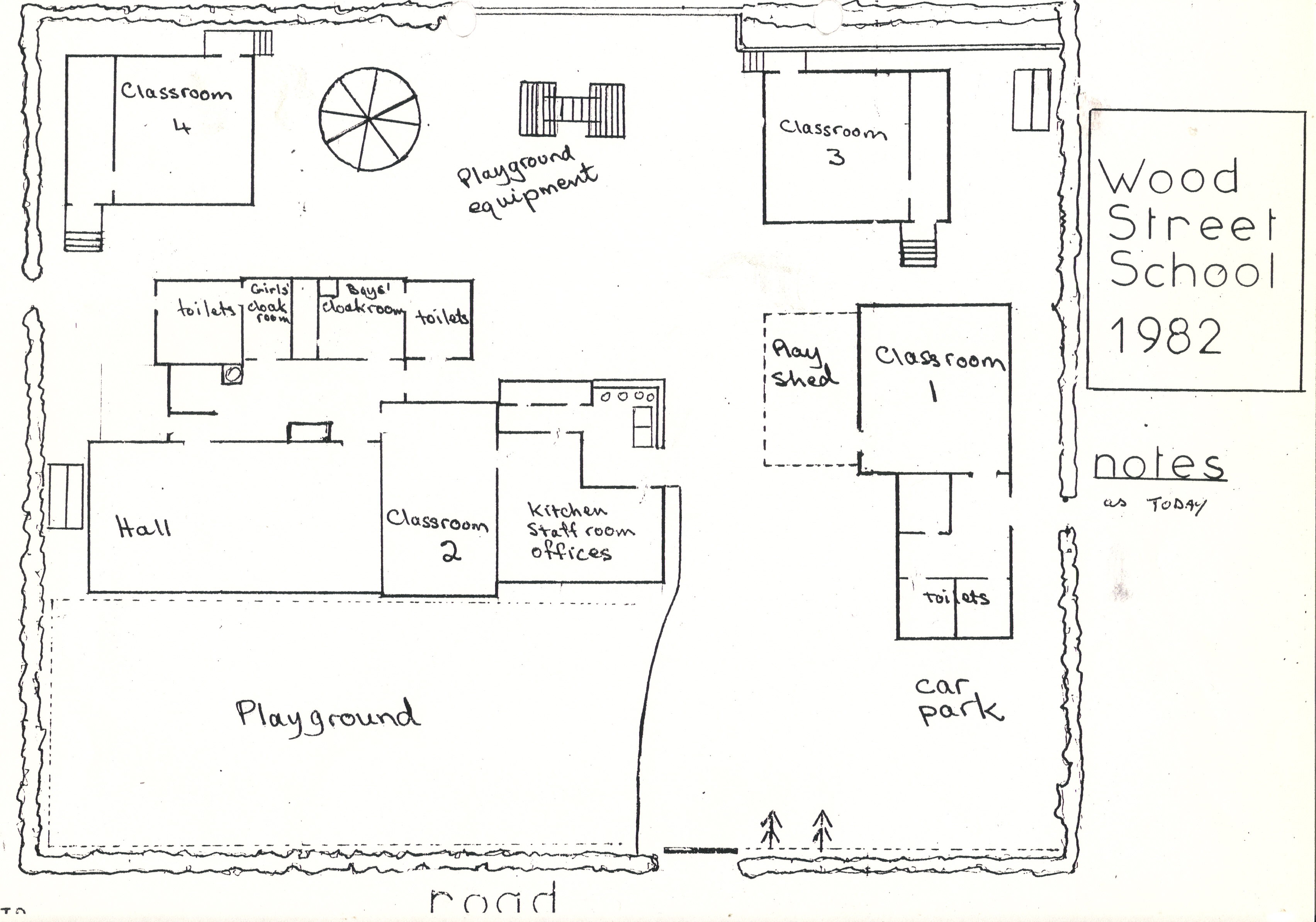
Wood Street School 1982
The school has now been a centre of village life for eleven decades ( 1988 ). The Sunday School, the Brownies and the Village Library have all used it as their headquarters in the past. We hope that it will continue to serve the community into the twenty-second century.